Hamburg, Germany
Work
Principal Investigator

Dr. Anjali Dhabu

University of Hamburg | Rotational seismology, earthquake engineering, and six-component ground motion.
DFG Individual Research Grant2024-2027Principal Investigator

HERS

Heterogeneities and Their Effect on Rotational Seismology

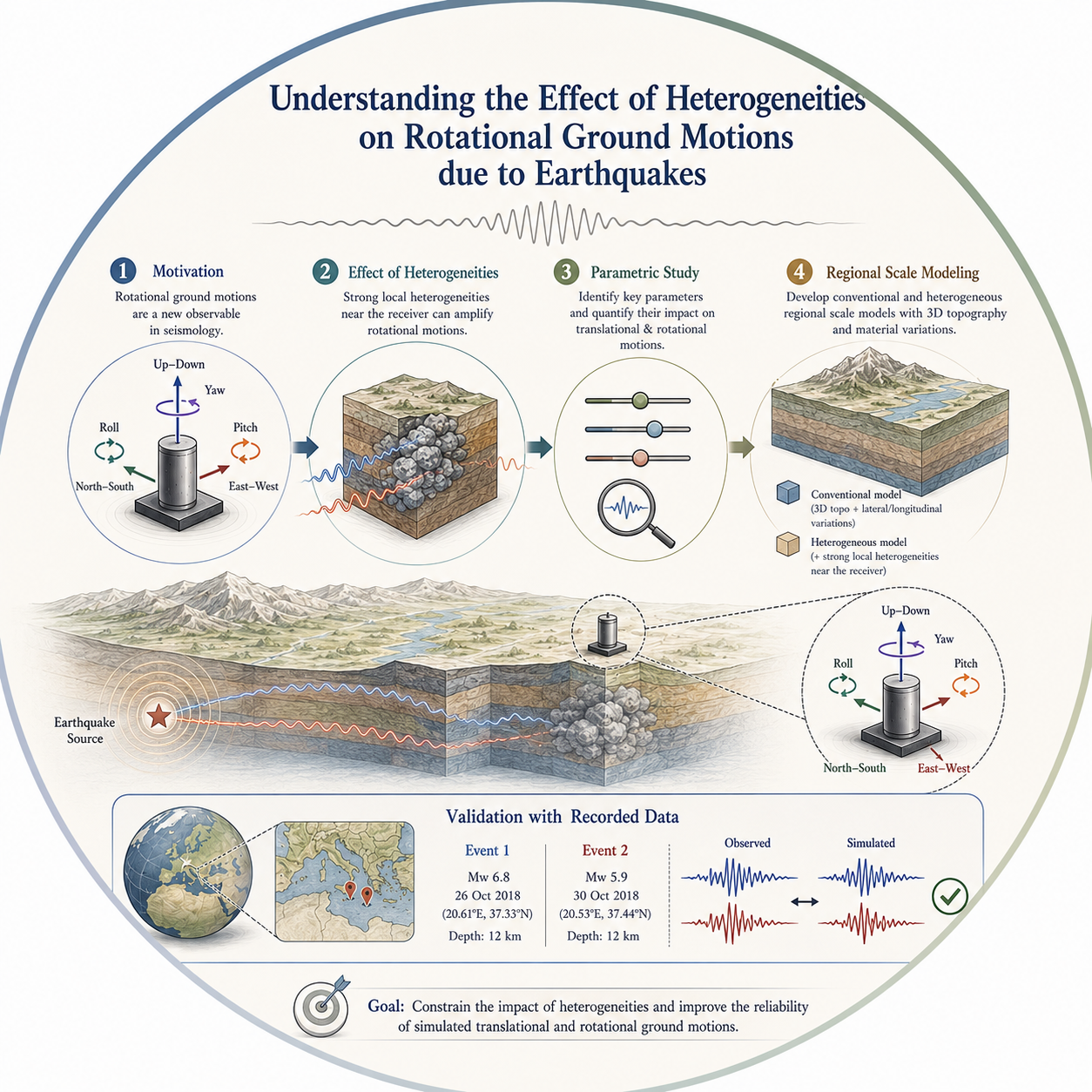
Leading a DFG-funded research project on how complex subsurface heterogeneities influence simulated rotational ground motions and strains, with the goal of improving links between rotational seismology and earthquake engineering.
AreaRotational SeismologyMethodHeterogeneous Media and Simulated RotationsOutputDFG Individual Research Grant, 2024-2027ToolFinite Element ModelingToolSpectral Element MethodsToolSeismic Wave Simulation
Heterogeneous subsurface model used to represent the HERS research direction.
HERS studies how complex subsurface structure changes translations, rotations, and strain in simulated earthquake motion.
Project Network

Research and cooperation partners for HERS.

Cooperation Partner

Professor Dr. Céline Hadziioannou

University of Hamburg

Institute of Geophysics
Cooperation Partner

Professor Dr. Heiner Igel

LMU Munich

Geophysics / Seismology
Cooperation Partner

Dr. Felix Bernauer

LMU Munich

Geophysics / Seismology
Cooperation Partner

Professor Dr. Yann Capdeville

CNRS / Nantes Université

Laboratoire de Planétologie et Géosciences

Guided Students

Research training connecting Earth heterogeneity and engineering seismology.
M.Sc. thesis co-supervision

Laurin Müller

Structural health monitoring of wind turbines using 6C ground-motion data.

B.Sc. thesis supervision

Nicolas Matthießen

Numerical simulation of seismic gradients and their response to Earth-medium heterogeneity.

M.Sc. thesis supervision

Ann Joseph

Analyzing effects of Earth heterogeneity on rotational seismology.
Central Research Question

What changes when Earth is no longer treated as simple?

Rotational seismology opens a richer view of earthquake motion. HERS asks how heterogeneous Earth structure changes simulated rotations, strains, and translations, and how those effects can be interpreted for seismology and earthquake engineering.

What this project is building.

  • Building capabilities for high-fidelity numerical simulation of rotations, translations, and strain in heterogeneous media.
  • Developing the extended SPECFEM simulation workflow for rotational ground-motion modeling.
  • A research bridge between rotational seismology, earthquake engineering, and structural response.
Research Workflow

From heterogeneous media to engineering interpretation.

The project links Earth model complexity, numerical simulation, rotational observables, and structural meaning in one coherent research line.
01

Heterogeneous Earth Structure

Define complex media where layers, inclusions, and spatial variability can reshape the seismic wavefield.
02

Large-Scale Numerical Simulation

Use spectral-element modeling workflows to compare translations, rotations, and strain-like quantities.
03

Observing Rotational Response

Identify how heterogeneity changes rotational ground motion and how those changes should be interpreted.
04

Engineering Interpretation

Translate wavefield gradients into questions that matter for earthquake engineering and structural response.
Contributions from the HERS Project

Expanding the capabilities for seismic research.

Research Outputs

Publications from the HERS Project.

Current and planned outputs tied directly to the HERS research direction.
01Poster2026Completed

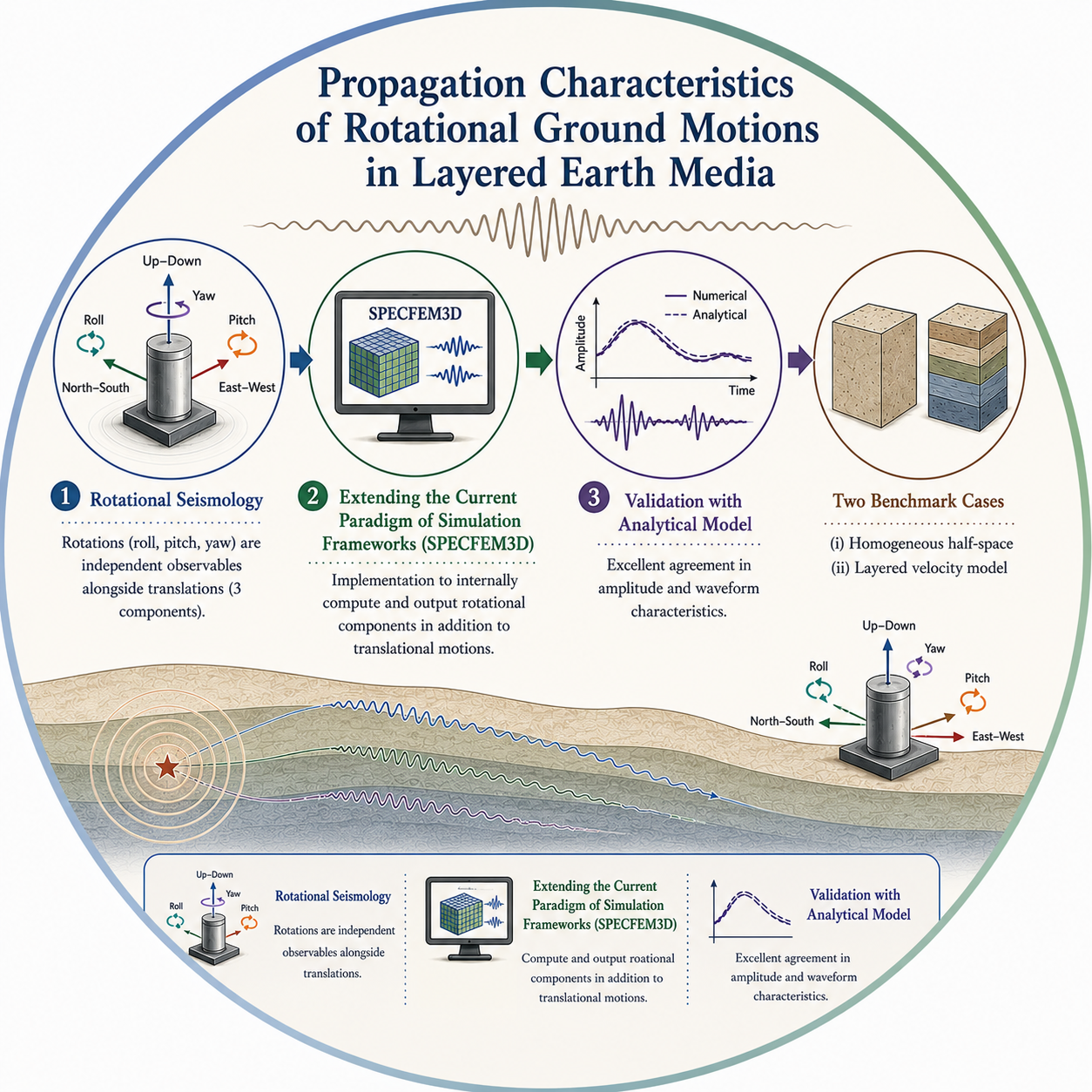
Propagation Characteristics of Rotational Ground Motions in Layered Earth Media

Dhabu, A.C., Nooghabi, A., and Hadziioannou, C.

Extended abstract accepted at EGU 2026. Manuscript in preparation for submission to Bulletin of the Seismological Society of America.

02Poster2026Completed

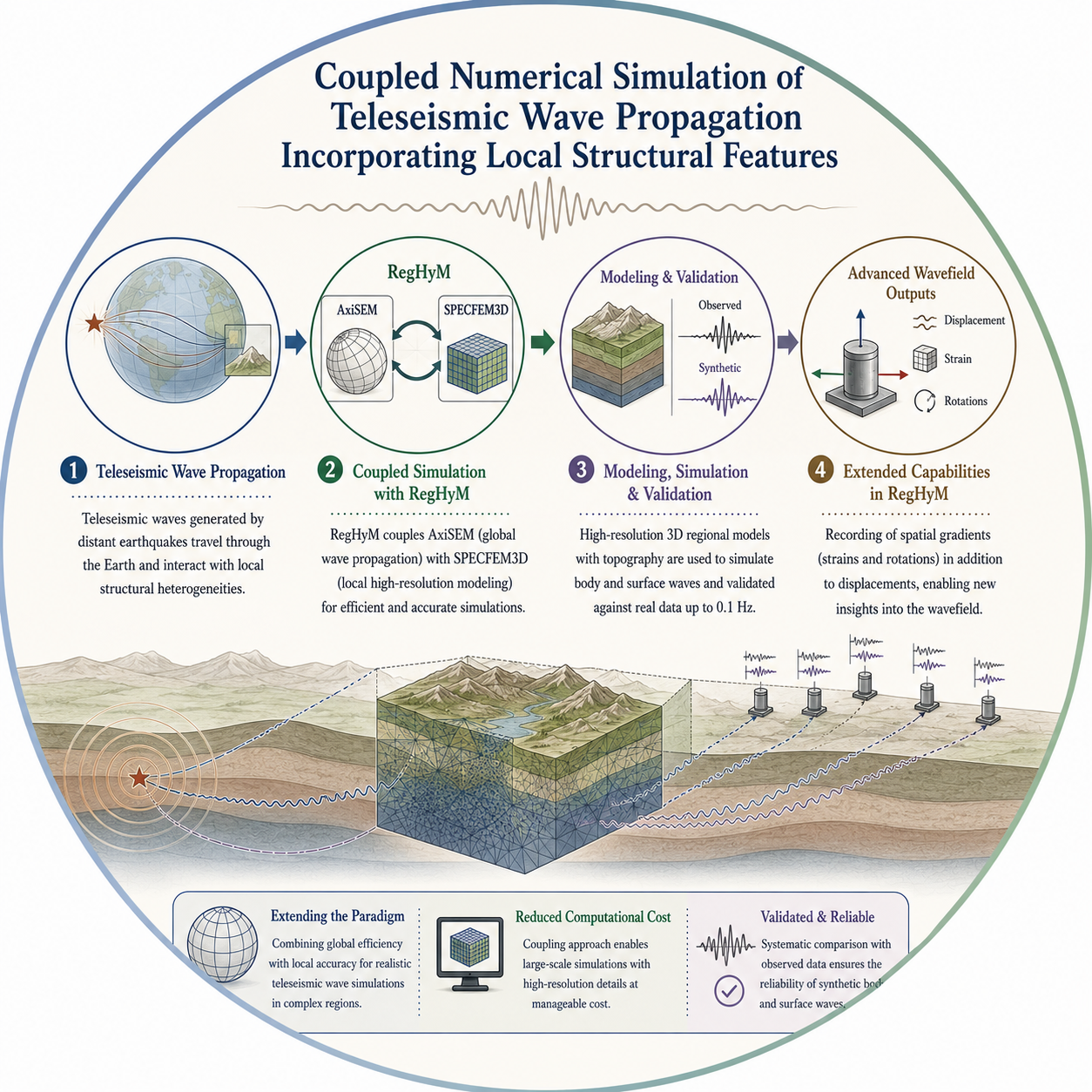
Coupled Numerical Simulation of Teleseismic Wave Propagation Incorporating Local Structural Features

Nooghabi, A., Dhabu, A.C., Monteiller, M., Matthiessen, N., and Hadziioannou, C.

Extended abstract accepted at EGU 2026.

03Poster2025Completed

Developing a High-Resolution Subsurface Model through Teleseismic Wave Simulation in Hamburg

Nooghabi, A., Dhabu, A.C., and Hadziioannou, C.

Extended abstract accepted at EGU 2025.

04Presentation2025Completed

6-Component Operational Modal Analysis of wind turbines for damage detection.

Müller, L., Dhabu, A., Bernauer, F., Donner, S., Bode, K., & Hadziioannou, C.

Presented at the 13th International Conference on Structural Health Monitoring of Intelligent Infrastructure.
Full publication page
Project page updated from research profile entry published April 1, 2024.