Hamburg, Germany

Publications

Research output by research theme.

Publications are organized using the same five research themes that structure the research vision.

Publication list
Visual overview of research themes: wavefield physics and theory, Earth and sources, computational modeling tools, observables and data, and structural health monitoring.

Collaboration Atlas

People, places, and citation paths around the publications.

Coauthor links, institutional homes, and incoming citation paths reveal how each research theme travels beyond the paper list.

16publications5themes12Institutions141citations

Featured collaborations · 6 of 12 institutions shown below. Explore the full network in the Institutions tab.

AnjaliDhabuNew ObservablesSHMComputational ModelingWavefield TheoryEarth StructureS.T.G. Raghukanth, 10 shared publications Affiliations: Indian Institute of Technology MadrasRaghukanthC. Hadziioannou, 8 shared publications Affiliations: University of HamburgHadziioannouF. Bernauer, 5 shared publications Affiliations: Ludwig Maximilian University of MunichBernauerA. Hejazi Nooghabi, 4 shared publications Affiliations: University of HamburgHejazi NooghabiC.M. Liao, 3 shared publications Affiliations: Federal Institute for Materials Research and TestingLiaoE. Niederleithinger, 3 shared publications Affiliations: Federal Institute for Materials Research and TestingNiederleithingerH. Igel, 3 shared publications Affiliations: Ludwig Maximilian University of MunichIgelP.S. Kumar, 2 shared publications Affiliations: National Geophysical Research InstituteKumarG. Balaskas, 1 shared publications Affiliations: University of HamburgBalaskasJ. Dhanya, 1 shared publications Affiliations: Indian Institute of Technology MadrasDhanyaJ. Wassermann, 1 shared publications Affiliations: Ludwig Maximilian University of MunichWassermannK. Bode, 1 shared publications Affiliations: Vestas Wind Systems, Vestas Deutschland GmbHBodeK.J.P. Lakshmi, 1 shared publications Affiliations: National Geophysical Research InstituteLakshmiK.P. Lakshmi, 1 shared publications Affiliations: National Geophysical Research InstituteLakshmiL. Muller, 1 shared publications Affiliations: University of HamburgMullerM. Monteiller, 1 shared publications Affiliations: Coauthor affiliation not specifiedMonteillerN. Krishna, 1 shared publications Affiliations: National Geophysical Research InstituteKrishnaN. Matthiessen, 1 shared publications Affiliations: University of HamburgMatthiessenP. Bonkowski, 1 shared publications Affiliations: Opole University of TechnologyBonkowskiR. Menon, 1 shared publications Affiliations: National Geophysical Research InstituteMenonR. Mohanty, 1 shared publications Affiliations: National Geophysical Research InstituteMohantyR.P. Rajasekhar, 1 shared publications Affiliations: Indian Space Research Organisation; ISRO-Space Applications Centre Ahmedabad IndiaRajasekharS. Donner, 1 shared publications Affiliations: BGR - Federal Institute for Geosciences and Natural ResourcesDonnerS. Sugumar, 1 shared publications Affiliations: Indian Institute of Technology MadrasSugumarS. Yuan, 1 shared publications Affiliations: Ludwig Maximilian University of MunichYuanT. Platz, 1 shared publications Affiliations: Max Planck Institute for Solar System Research; Planetary Science InstitutePlatzV.K. Singla, 1 shared publications Affiliations: Indian Institute of Technology MadrasSinglaZ. Zembaty, 1 shared publications Affiliations: Opole University of TechnologyZembaty

Reduced micropolar theory, rotations, wave propagation

Wavefield Physics & Theory

Foundational publications on reduced micropolar continua, rotational ground-motion theory, wave propagation, and benchmark solutions for earthquake loading.

4 Publications
01
Journal2021

Seismic wave propagation through layered reduced micropolar medium.

Dhabu, A.C., Singla, V.K. and Raghukanth, S.T.G.

Journal of Geophysical Research: Solid Earth. 126, e2020JB020931, 2021.

Publication insightsContribution, key finding, relevance, and my role
Contribution

Developed a layered reduced-micropolar framework for coupled translational and rotational seismic wave propagation.

Key finding / direction

Layering and micro-rotational effects can be modeled together to study rotational components in complex media.

Why it matters

It anchors the independent research line on rotational ground-motion physics.

My role

First author; led the theoretical formulation, modeling strategy, and interpretation.

02
Journal2021

Translational and rotational ground motion simulations in homogeneous reduced micropolar half-space.

Dhabu, A.C. and Raghukanth, S.T.G.

Journal of Seismology. 25, 599-623, 2021.

Publication insightsContribution, key finding, relevance, and my role
Contribution

Built a simulation route for translational and rotational ground motions in a reduced-micropolar half-space.

Key finding / direction

Reduced-micropolar models can generate rotational and translational ground-motion fields within one framework.

Why it matters

It bridges theory and computation for future 6C earthquake simulations.

My role

First author; developed the model implementation and linked the results to earthquake ground-motion questions.

03
Journal2019

Fundamental solutions to static and dynamic loads for homogeneous reduced micropolar half-space.

Dhabu, A.C. and Raghukanth, S.T.G.

Pure and Applied Geophysics. 176(11), 4881-4905, 2019.

Publication insightsContribution, key finding, relevance, and my role
Contribution

Derived fundamental solutions for static and dynamic loading in a homogeneous reduced-micropolar half-space.

Key finding / direction

The solutions provide benchmark responses for reduced-micropolar media under idealized loading.

Why it matters

It gives the mathematical base needed before studying layered and heterogeneous Earth models.

My role

First author; carried out the analytical development and engineering interpretation.

04
Conference2022

Reduced micropolar theory: An alternative to model the Earth medium and simulate earthquake ground motions?

Dhabu, A.C. and Raghukanth, S.T.G.

6th Conference of the International Working Group on Rotational Seismology. Paris, France, 2022.

Publication insightsContribution, key finding, relevance, and my role
Contribution

Positioned reduced-micropolar theory as an alternative way to represent Earth media for rotational ground-motion simulation.

Key finding / direction

Rotational effects can be treated as part of the medium model instead of only as derived motion components.

Why it matters

It shows continuity between doctoral theory and the current independent 6C research programme.

My role

First author and presenter; communicated the doctoral research direction to the rotational seismology community.

Heterogeneity, source processes, strong motion

Earth & Sources

Work on heterogeneous Earth structure, source processes, finite-fault slip, and the strong-motion source regions that control damaging earthquake motion.

1 Publication
01
Journal2019

Characterization of strong motion generation regions of earthquake slip using extreme value theory.

Dhabu, A.C., Sugumar, S. and Raghukanth, S.T.G.

Pure and Applied Geophysics. 176(8), 3567-3592, 2019.

Publication insightsContribution, key finding, relevance, and my role
Contribution

Used extreme value theory to characterize strong-motion generation regions of earthquake slip.

Key finding / direction

Extreme-value methods can help isolate slip regions most relevant to strong ground motion.

Why it matters

It broadens the profile from wave propagation to source processes that control damaging motions.

My role

First author; led the statistical characterization and seismological interpretation.

Teleseismic simulation, subsurface modeling, numerical workflows

Computational Modeling & Tools

Simulation workflows and tools for teleseismic-to-local modeling, subsurface structure, and scalable wavefield computation.

4 Publications
01
Preprint2026Preprint

Spectral Element Extension for Direct Simulation of Rotational Ground Motions.

Dhabu, A.C., Hejazi Nooghabi, A. and Hadziioannou, C.

arXiv preprint. arXiv:2610.09568, submitted 7 October 2026.

02
Conference2026

Propagation Characteristics of Rotational Ground Motions in Layered Earth Media

Dhabu, A.C., Hejazi Nooghabi, A., and Hadziioannou, C.

EGU General Assembly. Extended abstract and poster presentation, 2026.

03
Conference2026

Coupled Numerical Simulation of Teleseismic Wave Propagation Incorporating Local Structural Features

Hejazi Nooghabi, A., Dhabu, A.C., Monteiller, M., Matthiessen, N., and Hadziioannou, C.

EGU General Assembly. Extended abstract and poster presentation, 2026.

04
Conference2025

Developing a high-resolution subsurface model through teleseismic wave simulation in Hamburg.

Hejazi Nooghabi, A., Dhabu, A. and Hadziioannou, C.

EGU General Assembly. Vienna, Austria, EGU25-18687, 2025.

Publication insightsContribution, key finding, relevance, and my role
Contribution

Uses teleseismic wave simulation to support high-resolution subsurface modeling in Hamburg.

Key finding / direction

Teleseismic simulations can help constrain subsurface structure beneath an urban research setting.

Why it matters

It supports the site and structure context needed for future 6C monitoring studies.

My role

Co-author; contributes simulation interpretation and links to local ground-motion questions.

Topography, planetary surface evidence, seismic observations

Observables & Data

Publications using topographic datasets, recorded or surface-derived observations, and planetary evidence to interpret seismic shaking and active processes.

5 Publications
01
Journal2021

Influence of Himalayan topography on earthquake ground motions.

Dhabu, A.C. and Raghukanth, S.T.G.

Arabian Journal of Geosciences. 14, article 1931, 2021.

Publication insightsContribution, key finding, relevance, and my role
Contribution

Quantified how Himalayan topography modifies earthquake ground motions through numerical modeling.

Key finding / direction

Mountainous terrain can meaningfully change simulated ground-motion patterns.

Why it matters

It connects wave-propagation modeling with regionally relevant seismic hazard questions.

My role

First author; designed the simulation study and led analysis of topographic effects.

02
Conference2018

Influence of Himalayan topography on earthquake strong ground motions.

Dhabu, A.C. and Raghukanth, S.T.G.

1st Conference of the Arabian Journal of Geosciences. Hammamet, Tunisia, 2018.

Publication insightsContribution, key finding, relevance, and my role
Contribution

Presented the conference-stage development of Himalayan topography effects on strong ground motions.

Key finding / direction

Topographic amplification and scattering are important ingredients in mountain-region ground-motion studies.

Why it matters

It shows early continuity in connecting numerical modeling with seismic hazard problems.

My role

First author; led the study design and dissemination.

03
Conference2016

Effect of topography on earthquake ground motions.

Dhabu, A., Dhanya, J. and Raghukanth, S.T.G.

Structural Engineering Convention. Chennai, India, 2016.

Publication insightsContribution, key finding, relevance, and my role
Contribution

Introduced topographic effects on earthquake ground motions to a structural engineering audience.

Key finding / direction

Terrain geometry can be an important control on simulated earthquake response.

Why it matters

It marks the start of a long-term bridge between seismology and structural engineering.

My role

First author; developed the study with collaborators and framed the engineering relevance.

04
Journal2019

The seismically active lobate scarps and co-seismic lunar boulder avalanches triggered by 3rd January 1975 (Mw 4.1) shallow moonquake.

Kumar, P.S., Mohanty, R., Lakshmi, K.J.P., Raghukanth, S.T.G., Dhabu, A.C., Rajasekhar, R.P. and Menon, R.

Geophysical Research Letters. 46(14), 7972-7981, 2019.

Publication insightsContribution, key finding, relevance, and my role
Contribution

Linked lunar scarps and boulder avalanches with a shallow moonquake event.

Key finding / direction

Surface geomorphology can preserve evidence of recent seismic activity on the Moon.

Why it matters

It shows the transferability of seismological thinking beyond terrestrial earthquake engineering.

My role

Co-author; contributed earthquake-source and ground-motion expertise to the planetary study.

05
Journal2019

Recent seismicity in Valles Marineris, Mars: Insights from young faults, landslides, boulder falls and possible mud volcanoes.

Kumar, P.S., Krishna, N., Lakshmi, K.P., Raghukanth, S.T.G., Dhabu, A. and Platz, T.

Earth and Planetary Science Letters. 505, 51-64, 2019.

Publication insightsContribution, key finding, relevance, and my role
Contribution

Investigated recent Martian seismicity using young faults, landslides, boulder falls, and possible mud volcanoes.

Key finding / direction

Geomorphic evidence points to active or recent tectonic processes in Valles Marineris.

Why it matters

It adds breadth in planetary seismology while keeping source characterization as the common thread.

My role

Co-author; contributed seismicity and geophysical interpretation within the planetary collaboration.
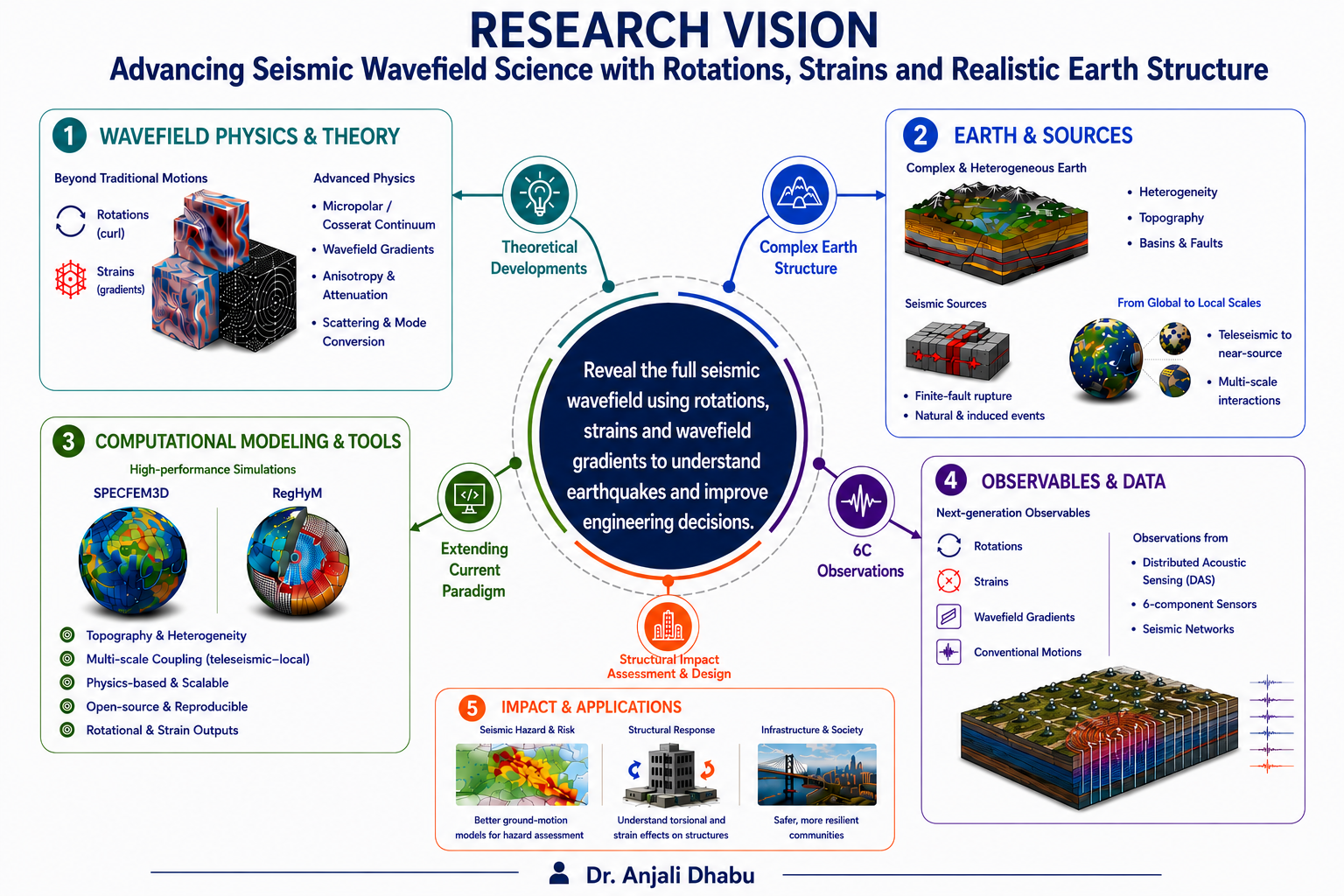
6C sensing, structural dynamics, infrastructure monitoring

Structural Health Monitoring

Publications and presentations connecting 6C sensing, rotational measurements, modal analysis, bridge response, and infrastructure monitoring.

5 Publications
01
Preprint2024Preprint

Characterizing rotational ground motions: Implications for earthquake-resistant design of bridge structures.

Dhabu, A.C., Bernauer, F., Liao, C.M., Niederleithinger, E., Igel, H. and Hadziioannou, C.

arXiv preprint. arXiv:2411.02203, 2024.

Publication insightsContribution, key finding, relevance, and my role
Contribution

Connected rotational ground-motion characterization with earthquake-resistant bridge design.

Key finding / direction

Rotational components can change how bridge response and design demand are interpreted.

Why it matters

It is the clearest evidence of the 6C seismology to infrastructure resilience research identity.

My role

Lead author; integrated seismological modeling with structural engineering interpretation.

02
Conference2025

6-Component operational modal analysis of wind turbines for damage detection.

Muller, L., Dhabu, A., Bernauer, F., Donner, S., Bode, K. and Hadziioannou, C.

13th International Conference on Structural Health Monitoring of Intelligent Infrastructure. Graz, Austria, 2025.

Publication insightsContribution, key finding, relevance, and my role
Contribution

Applies 6-component operational modal analysis to wind turbines for damage detection.

Key finding / direction

Six-component measurements can enrich modal analysis beyond conventional translational observations.

Why it matters

It extends the 6C monitoring programme from earthquake response toward renewable-energy infrastructure.

My role

Co-author; contributes rotational sensing and structural-response expertise.

03
Invited Talk2024

Applications of rotational sensing in analyzing structural vibrations and their modal analyses.

Bernauer, F., Bonkowski, P., Dhabu, A. and Zembaty, Z.

18th World Conference in Earthquake Engineering. Keynote contribution, Milan, Italy, 2024.

Publication insightsContribution, key finding, relevance, and my role
Contribution

Synthesized applications of rotational sensing for structural vibration and modal analysis.

Key finding / direction

Rotational sensing adds information that can sharpen interpretation of structural vibrations.

Why it matters

It demonstrates visibility of the work in the earthquake-engineering community.

My role

Co-author; contributed expertise on rotations, structural response, and seismological measurement.

04
Conference2023

Seismic monitoring of civil engineering structures with 6C measurements.

Bernauer, F., Balaskas, G., Hadziioannou, C., Dhabu, A., Liao, C.M., Niederleithinger, E., Yuan, S., Wassermann, J. and Igel, H.

AGU Fall Meeting. Abstract S54C-06, 2023.

Publication insightsContribution, key finding, relevance, and my role
Contribution

Presented 6C seismic monitoring as a tool for observing civil engineering structures.

Key finding / direction

Combining translational and rotational measurements can improve interpretation of structural motion.

Why it matters

It strengthens the collaborative pathway from seismology instrumentation to infrastructure monitoring.

My role

Co-author; contributed rotational ground-motion and structural monitoring perspective.

05
Conference2023

Using rotational motions to understand material damage in civil engineering structure.

Dhabu, A., Bernauer, F., Liao, C.M., Hadziioannou, C., Igel, H. and Niederleithinger, E.

EGU General Assembly. Abstract EGU-8851, 2023.

Publication insightsContribution, key finding, relevance, and my role
Contribution

Examined how rotational motions can help understand material damage in civil engineering structures.

Key finding / direction

Rotational motion may provide diagnostic information about structural behavior and damage processes.

Why it matters

It makes the structural-resilience case for six-component measurements explicit.

My role

First author; led the framing and dissemination of the damage-focused application.