
Hamburg, Germany
WorkApril 1, 2025

Coupled Teleseismic Ground-Motion Simulation

Contributed to coupled ground-motion simulation research for teleseismic events and high-resolution subsurface modeling in Hamburg, linking computational seismology with observation-driven wave-field analysis.View publication or abstract
AreaComputational SeismologyMethodTeleseismic Wave-Field SimulationOutputErUM-WAVE and Hamburg Subsurface ModelingToolSpectral Element MethodsToolSPECFEMToolWave-Field SimulationToolSubsurface Modeling
Coupled Teleseismic Ground-Motion Simulation
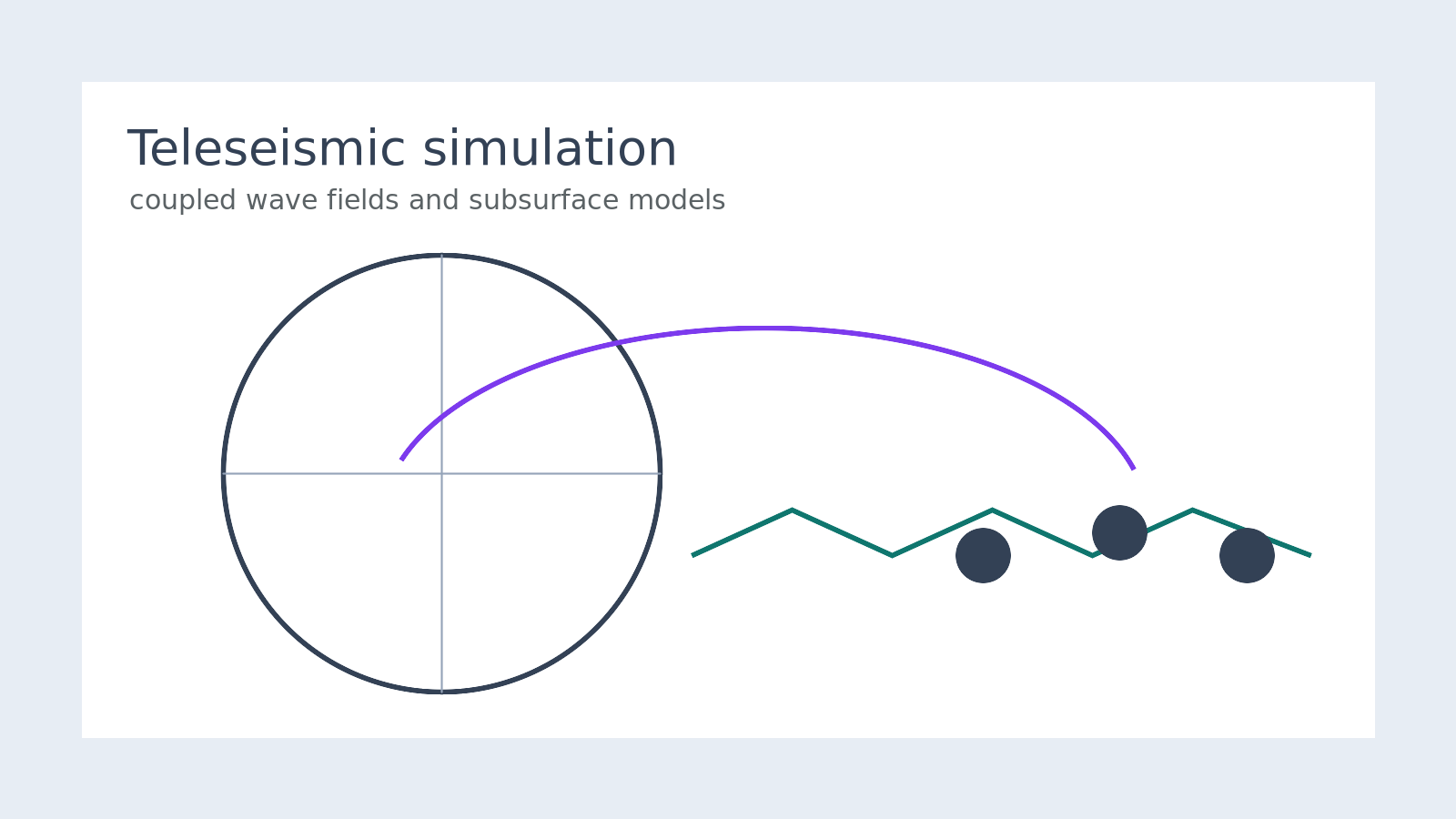
Teleseismic events can be used to study wave fields and subsurface structure, but realistic simulation requires coupling source, propagation, and local structure carefully. This project asks how coupled ground-motion simulation can support high-resolution subsurface modeling and interpretation of complex wave fields. The work contributes to computational seismology workflows that connect teleseismic wave simulation with local and regional structure. It sits within the broader ErUM-WAVE research context and supports high-resolution subsurface modeling through simulation-informed interpretation. This case study shows the computational side of Dr. Dhabu's work at the University of Hamburg. It complements the HERS project by focusing on coupled simulation and wave-field analysis rather than only rotational response in heterogeneous media.
  • Manuscript in preparation on coupled ground-motion simulation for teleseismic events.
  • EGU 2025 contribution on developing a high-resolution subsurface model through teleseismic wave simulation in Hamburg.
  • Research experience in spectral-element and wave-field simulation workflows.
Better subsurface models improve how researchers understand seismic wave propagation, local site response, and the link between observed motion and Earth structure. Coupled simulation helps make those interpretations more physically grounded.