Hamburg, Germany
WorkMay 1, 2024

Extending SPECFEM for Rotational Ground-Motion Simulation

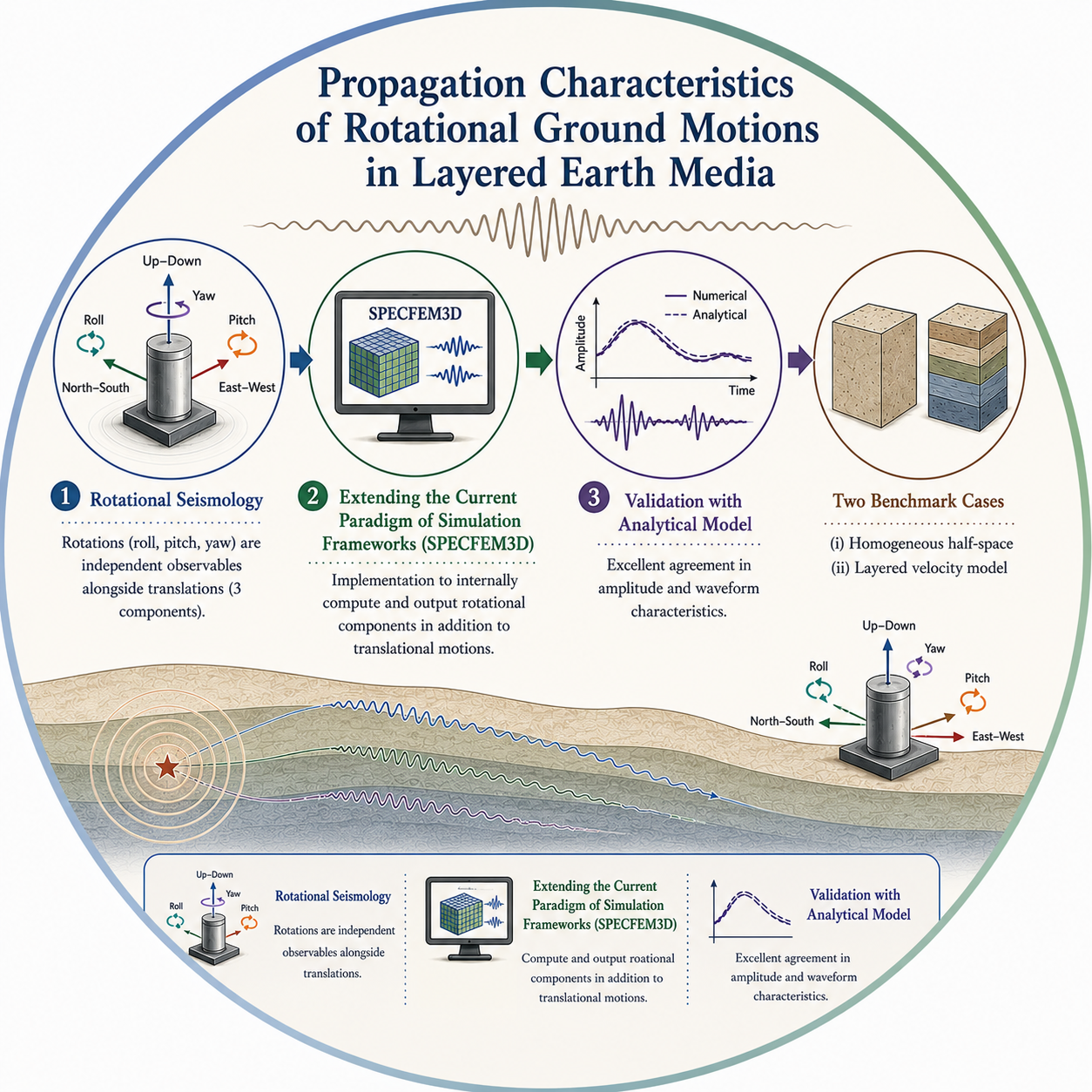
Associated with the HERS research direction, this project extends SPECFEM-based simulation workflows so rotational ground motions can be computed and interpreted alongside translational wavefields in layered and heterogeneous Earth models.
AreaComputational Rotational SeismologyMethodSPECFEM Extension and Rotational ComponentsOutputHERS technical workflowToolSPECFEMToolSpectral Element MethodsToolRotational Ground MotionsToolLayered Earth ModelsToolWavefield Post-Processing

Extending SPECFEM for Rotational Ground-Motion Simulation
SPECFEM simulations provide a strong basis for modeling seismic wave propagation, but HERS requires workflows that make rotations and related derived quantities available for interpretation. This project asks how SPECFEM-based simulations can be extended and post-processed so rotational ground motions can be studied together with translations in layered and heterogeneous media. The work develops simulation and post-processing steps for extracting rotational components from spectral-element wavefields. It connects model design, source setup, receiver output, and interpretation of rotational quantities so the same computational workflow can support both physical benchmarking and HERS-style heterogeneous-media experiments. This project is a technical bridge between the theoretical rotational-seismology foundations and the current HERS research programme. It supports the ability to test how model complexity, layering, and heterogeneity affect rotational ground-motion amplitudes and wavefield behavior. Rotational seismology becomes more useful when rotations can be computed from realistic wave-propagation simulations and compared with translational motion. Extending SPECFEM workflows in this direction supports the HERS simulation programme.