Project Summary
Research Problem
Methods and Technical Expertise
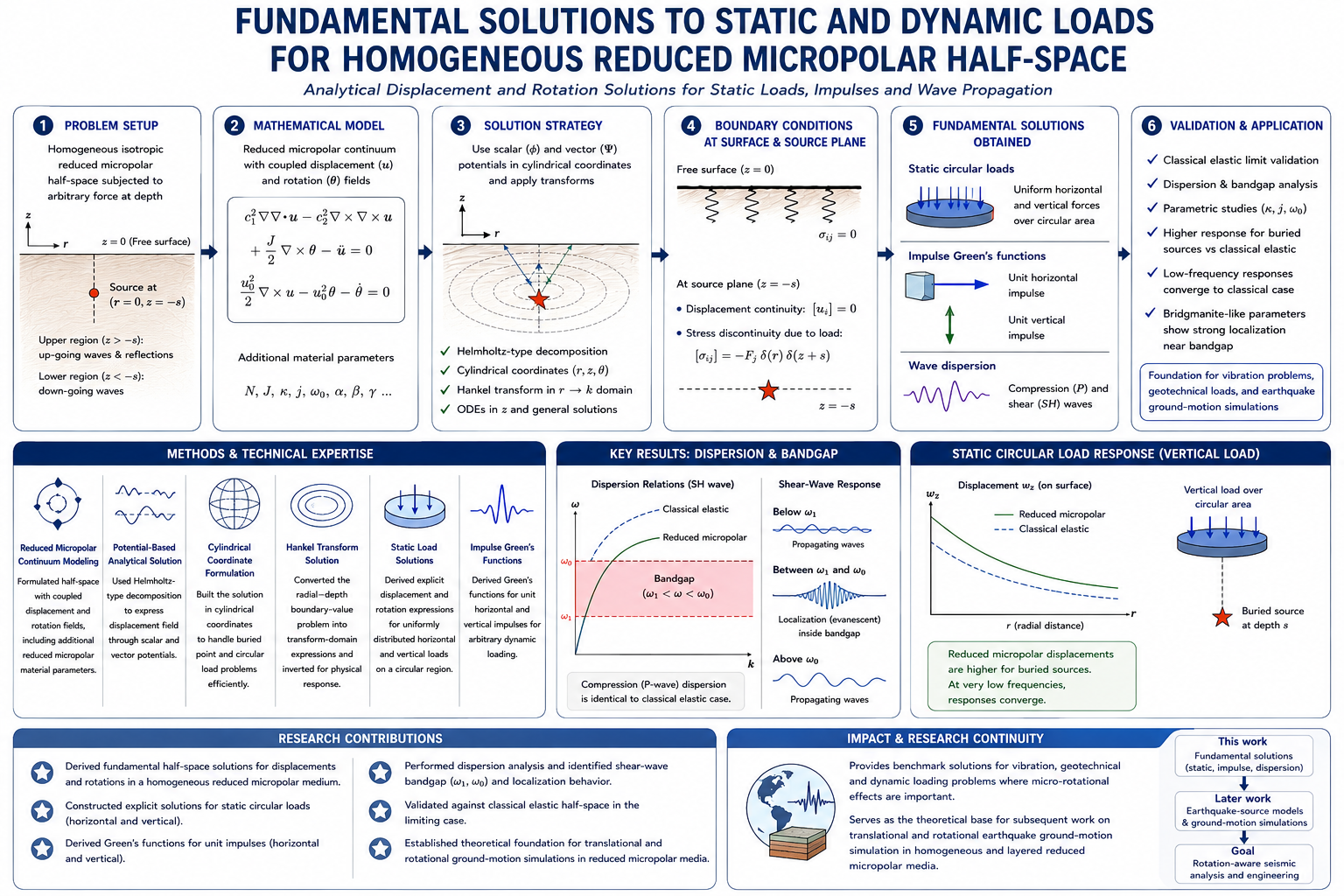
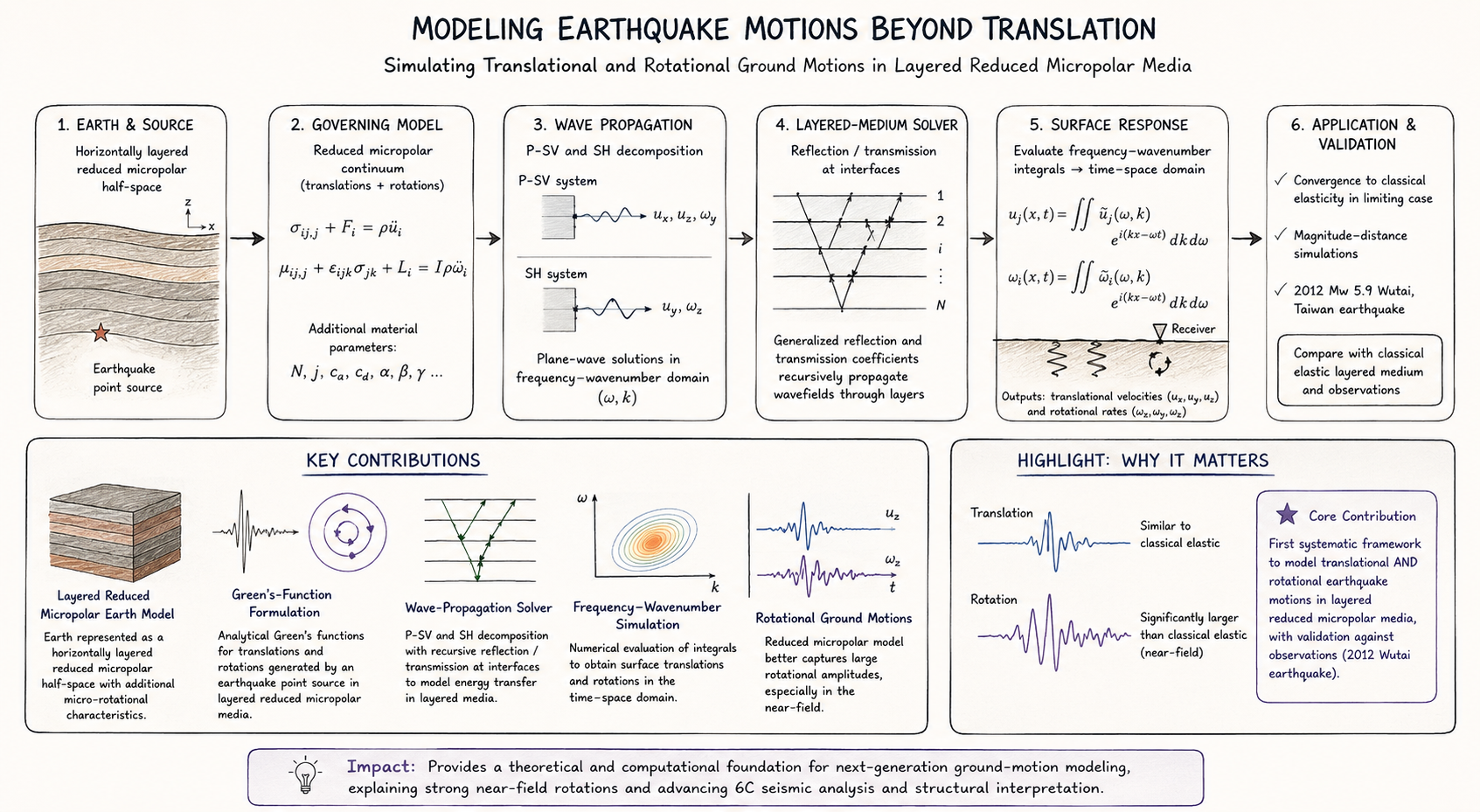
- Reduced Micropolar Continuum Modeling: Formulated layered Earth media using reduced micropolar material behavior with translations and rotations represented together.
- Analytical Wave Propagation: Derived Green's functions for layered reduced micropolar half-space response under earthquake loading.
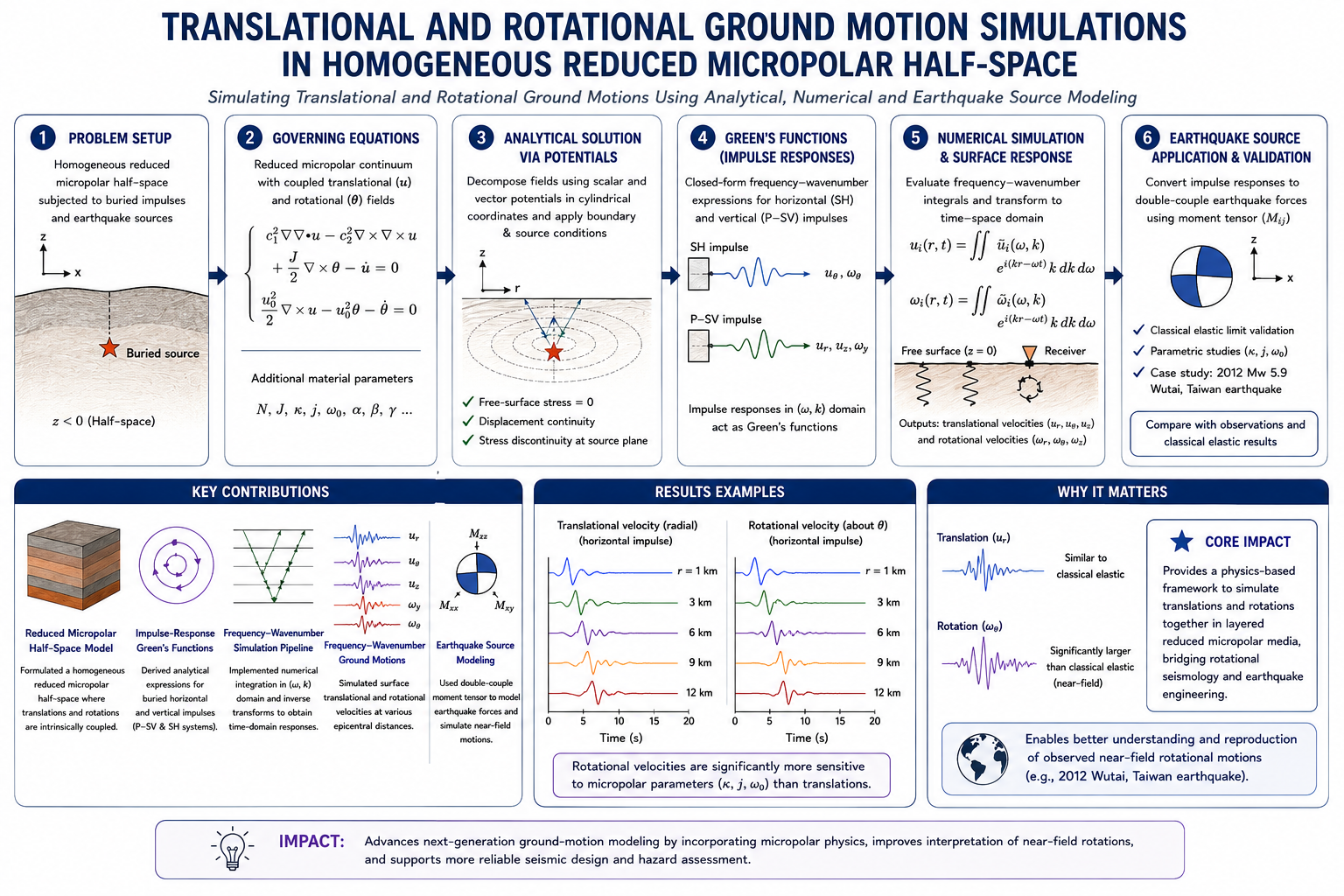
- P-SV and SH Wave Decomposition: Separated the coupled wave-propagation problem into independent P-SV and SH systems for tractable computation.
- Layered-Medium Recursion: Used generalized reflection and transmission coefficients to propagate wavefields through multiple horizontal layers.
- Numerical Simulation: Evaluated frequency-wavenumber integrals to compute surface translations and rotations in the time-space domain.
- Validation and Benchmarking: Checked limiting cases against classical elastic layered media and compared simulated motions for the 2012 Wutai earthquake.
- Research Programming: Implemented computational routines for simulated translational velocities, rotational rates, and source-to-site response analysis.
Research Contributions
- Layered reduced micropolar Earth model: Built a theoretical representation of the Earth as a horizontally layered reduced micropolar half-space, with each layer described through elastic, density, rotational inertia, and additional reduced micropolar material parameters.
- Green's-function formulation: Derived analytical Green's functions for the response of layered reduced micropolar media subjected to earthquake force, enabling surface translations and rotations to be computed from the same framework.
- Wave-propagation solver structure: Reduced the propagation problem into P-SV and SH components and used reflection/transmission recursions at layer interfaces to model energy transfer through layered media.
- Classical-elastic validation workflow: Tested the formulation by choosing reduced micropolar parameters that converge toward the classical elastic case, then comparing simulated translational and rotational responses.
- Earthquake simulation case study: Simulated ground motions for the 2012 Mw 5.9 Wutai, Taiwan earthquake and compared reduced micropolar results with classical elastic layered-medium simulations.
- Reusable simulation codebase: Produced code for generating simulated ground motions, later made available through the paper's data repository.
Key Findings
- Translational velocities from the layered reduced micropolar model remained close to those from the layered classical elastic model.
- Rotational rates were substantially more sensitive to the reduced micropolar material representation than translational motions.
- For magnitude-distance simulations, rotational rates from the reduced micropolar half-space were higher than those from the classical elastic half-space.
- For the 2012 Wutai earthquake, the simulated vertical-axis peak rotational motion agreed well with the value reported in the literature.
- The results indicate that reduced micropolar theory can help explain large rotational amplitudes observed in near-field earthquake records.