
Project Summary
Research Problem
Method
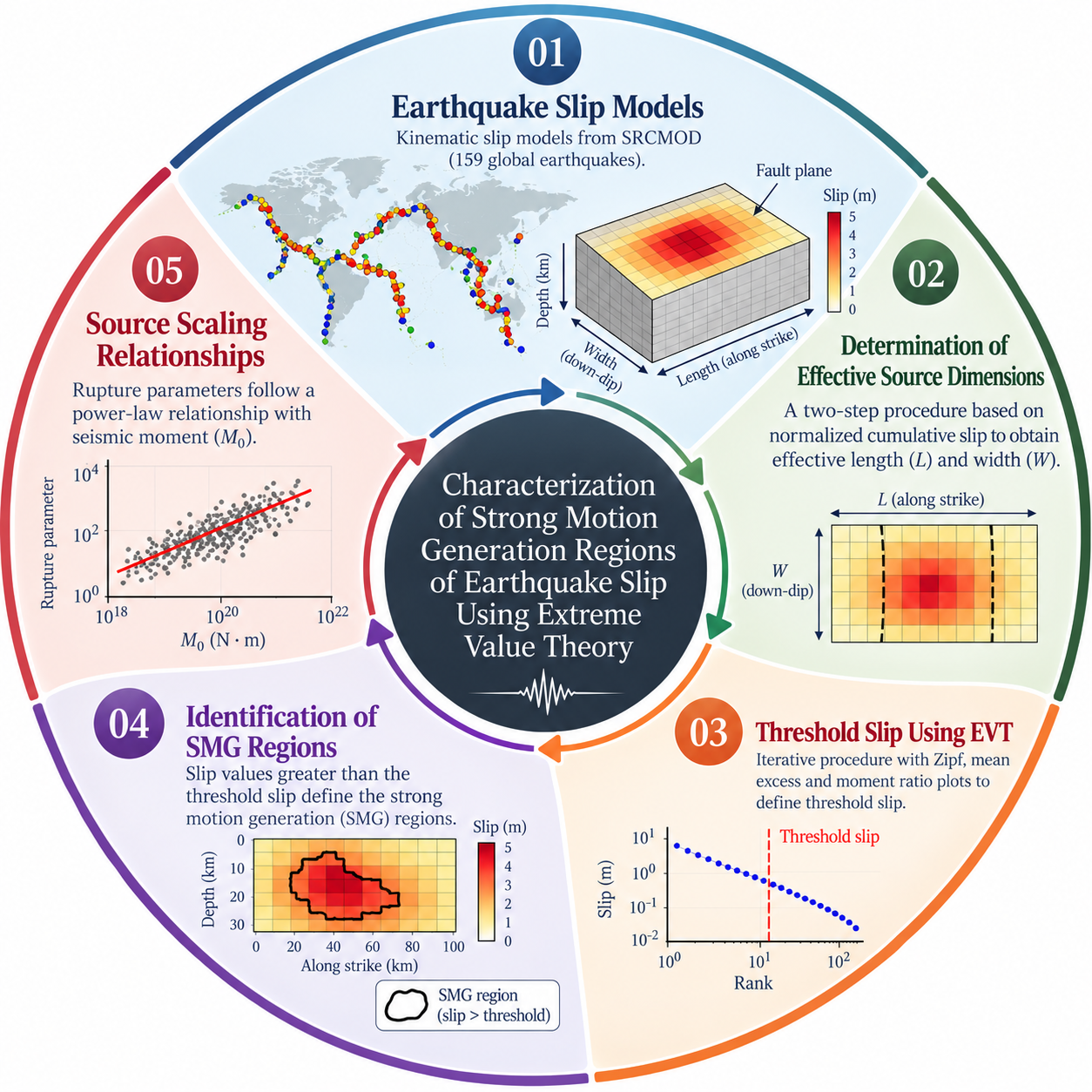
- Effective slip dimensions: Developed a strong-motion-duration-based trimming method to remove insignificant edge rows and columns while conserving the source regions that dominate the rupture process.
- Extreme-value thresholding: Used Zipf plots, mean excess function plots, and moment-ratio plots as a three-step procedure to identify a threshold slip for each model.
- Generalized Pareto modeling: Defined the strong-motion generation region as the part of the effective slip model where slip exceeds the threshold and follows a generalized Pareto distribution.
- Source-scaling relationships: Estimated effective length, effective width, effective area, effective mean slip, threshold slip, and area of strong-motion generation as functions of seismic moment.
- Comparison with prior methods: Compared the proposed source-scaling relations with approaches from Somerville et al., Mai and Beroza, and Mai et al.
Research Contributions
- Proposed an extreme-value-theory definition of strong-motion generation regions in earthquake slip models.
- Introduced an effective rupture-dimension workflow based on strong motion duration and cumulative slip contribution.
- Applied the method to 159 SRCMOD slip models spanning reverse, strike-slip, and normal fault mechanisms.
- Derived source-scaling equations for rupture dimensions, mean effective slip, threshold slip, and strong-motion generation area.
- Showed that the high-slip tail is better treated separately from the main slip distribution, supporting a two-part statistical interpretation of earthquake slip.
Key Findings
- Most effective slip models broadly follow an exponential distribution, but the largest slip values deviate from that distribution.
- The largest slip values can be modeled as extremes using the generalized Pareto distribution after a suitable threshold is chosen.
- Regions with slip above the threshold provide a statistically grounded definition of strong-motion generation regions.
- Effective rupture dimensions and strong-motion generation areas increase approximately linearly with seismic moment on a logarithmic scale.
- For a given seismic moment, the proposed area of strong-motion generation is smaller than asperity or large-slip areas estimated by several earlier empirical definitions.
My Role
Figures


