Hamburg, Germany
WorkMay 30, 2019

Fundamental Solutions for Reduced Micropolar Half-Space

Derived fundamental displacement and rotation solutions for static and dynamic loading in a homogeneous reduced micropolar half-space, including uniformly distributed circular loads, impulse Green's functions, classical-elastic validation, and dispersion analysis.View publication or abstract
AreaGround-Motion TheoryMethodFundamental Solutions for Reduced Micropolar MediaOutputPure and Applied Geophysics Publication and Ph.D. ResearchToolReduced Micropolar TheoryToolMethod of PotentialsToolHankel TransformsToolGreen's FunctionsToolDispersion Analysis
Fundamental Solutions for Reduced Micropolar Half-Space
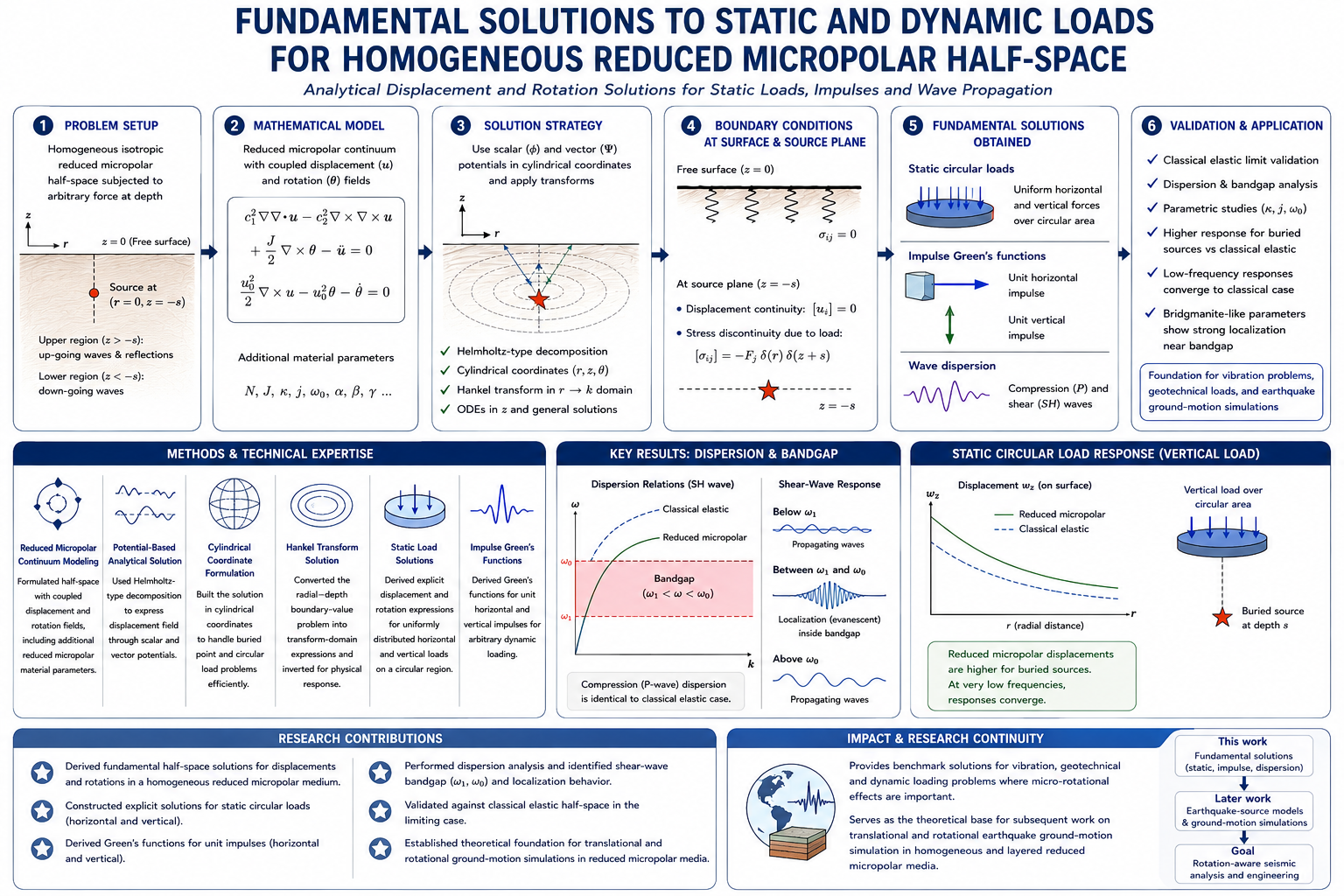
I derived fundamental solutions for a homogeneous reduced micropolar half-space subjected to static and dynamic loading. The work developed analytical expressions for both displacements and rotations, making it possible to study how a medium with independent particle rotations responds to buried forces and impulses. The study focused on a reduced micropolar representation of the Earth medium, where the stress tensor can be asymmetric but the formulation requires fewer additional material constants than full Cosserat theory. This made the model useful as a bridge between classical elastic half-space theory and later rotational ground-motion simulation. Classical elastic half-space solutions are widely used in seismology, geotechnical engineering, and earthquake engineering, but they do not explicitly represent independent micro-rotations. This becomes limiting when rotational motions measured during earthquakes are larger than values inferred from classical displacement gradients. The central research question was whether a homogeneous reduced micropolar half-space could be given the same kind of usable fundamental solutions that exist for classical elasticity: solutions for static loads, buried impulses, and wave dispersion that can later be assembled into more realistic earthquake-source models. The model considered a homogeneous isotropic reduced micropolar half-space subjected to an arbitrary force at depth. The loading plane divided the medium into an upper region containing up-going waves and free-surface reflections, and a lower region containing down-going waves. The derivation used scalar and vector potentials in cylindrical coordinates. Hankel transforms converted the governing partial differential equations into ordinary differential equations in depth. Boundary conditions were imposed at the free surface and source plane:
  • Free surface: zero stress at the surface.
  • Source plane: continuity of displacement across the plane of loading.
  • Load representation: stress discontinuity at the plane where the force is applied.
This produced transformed expressions for displacement and rotation components in both regions of the half-space.
  • Reduced Micropolar Continuum Modeling: Formulated the half-space with coupled displacement and rotation fields, including additional reduced micropolar material parameters.
  • Potential-Based Analytical Solution: Used Helmholtz-type decomposition to express the displacement field through scalar and vector potentials.
  • Cylindrical Coordinate Formulation: Built the solution in cylindrical coordinates to handle buried point and circular load problems efficiently.
  • Hankel Transform Solution: Converted the radial-depth boundary-value problem into transform-domain expressions that could be inverted for physical response.
  • Static Load Solutions: Derived explicit displacement and rotation expressions for uniformly distributed horizontal and vertical loads acting over a circular region.
  • Impulse Green's Functions: Derived Green's functions for unit horizontal and vertical impulses, enabling later response calculations for arbitrary dynamic loading.
  • Dispersion Analysis: Compared compression- and shear-wave dispersion for multiple reduced micropolar material parameter sets.
  • Fundamental half-space solution: Derived analytical displacement and rotation solutions for a homogeneous reduced micropolar half-space subjected to finite buried loading.
  • Static circular-load response: Developed explicit expressions for uniformly distributed horizontal and vertical forces acting over a circular area.
  • Classical-elastic validation: Verified the displacement solutions against available classical elastic half-space results in the limiting case.
  • Impulse Green's functions: Produced Green's functions for unit horizontal and vertical impulses, providing a reusable basis for dynamic loading and earthquake-source simulation.
  • Rotation-aware response: Extended conventional half-space response analysis by computing rotations directly from the reduced micropolar formulation.
  • Bandgap and dispersion interpretation: Showed how reduced micropolar parameters affect shear-wave dispersion and the frequency bandgap where localization behavior can occur.
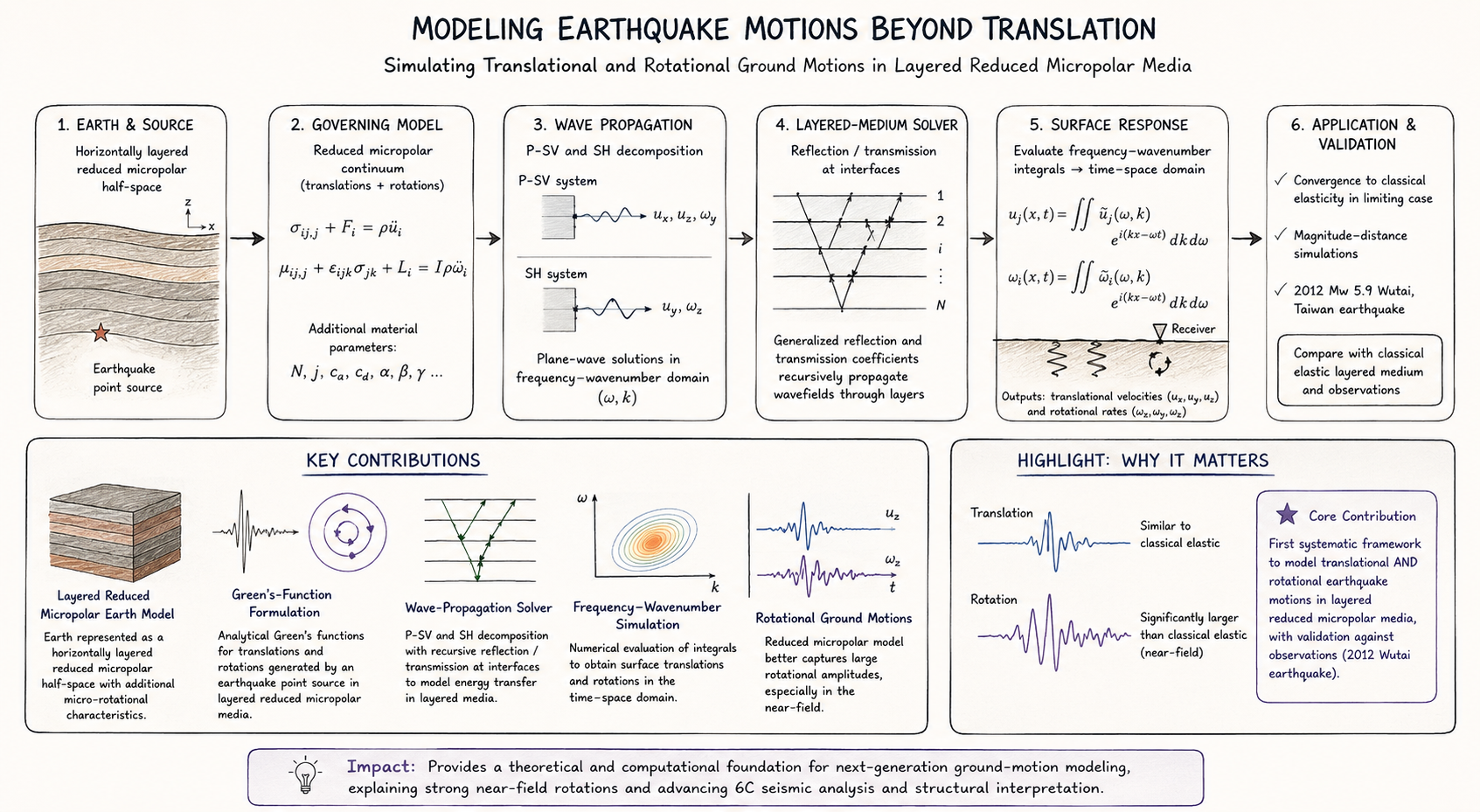
  • Foundation for later simulations: Provided the theoretical base for later work on translational and rotational ground-motion simulations in homogeneous and layered reduced micropolar media.
  • The compression-wave dispersion relation remains equivalent to the classical elastic case, while the shear-wave dispersion relation changes because of the reduced micropolar material parameters.
  • The shear-wave response can include a frequency bandgap between limiting frequencies w1 and w0, where wave localization becomes important.
  • Parametric analysis showed that the width of this bandgap depends strongly on the reduced micropolar stiffness parameter and rotational inertia.
  • For static circular loading, the reduced micropolar displacement solutions converge to classical elastic half-space solutions when the additional material parameters approach the classical limit.
  • For buried sources, displacement magnitudes in the reduced micropolar half-space can be higher than in the corresponding classical elastic half-space.
  • At very low frequencies, reduced micropolar and classical elastic responses become nearly identical.
  • For bridgmanite-like material parameters, response near the bandgap showed stronger localization for buried loading than for loading applied at the free surface.
I led the analytical derivation, validation strategy, dispersion study, interpretation, and manuscript preparation for this work. I developed the reduced micropolar half-space formulation with co-author guidance, derived the load-specific solutions, compared limiting cases against classical elastic theory, and identified how the additional material parameters influence displacement, rotation, and dispersion behavior. The most difficult part of the work was turning a coupled translation-rotation continuum model into fundamental solutions that are still usable for engineering and seismological problems. The derivation required careful handling of potential functions, Hankel transforms, source-plane discontinuities, and free-surface boundary conditions. A second challenge was interpreting material parameters that are not routinely measured for Earth media. The dispersion and bandgap analysis became a way to understand the physical role of those parameters and to identify where reduced micropolar behavior departs most clearly from classical elasticity. This project established benchmark solutions for reduced micropolar half-space response under static and dynamic loads. The results can be used for vibration-related problems, geotechnical loading, and impulse-response calculations in media where micro-rotational effects may matter. The work became a theoretical foundation for subsequent research on translational and rotational earthquake ground-motion simulation, including the later homogeneous half-space earthquake-source workflow and the layered reduced micropolar model for rotational seismology. Dhabu, A. C., & Raghukanth, S. T. G. (2019). Fundamental solutions to static and dynamic loads for homogeneous reduced micropolar half-space. Pure and Applied Geophysics, 176, 4881-4905. https://doi.org/10.1007/s00024-019-02225-0

Related projects

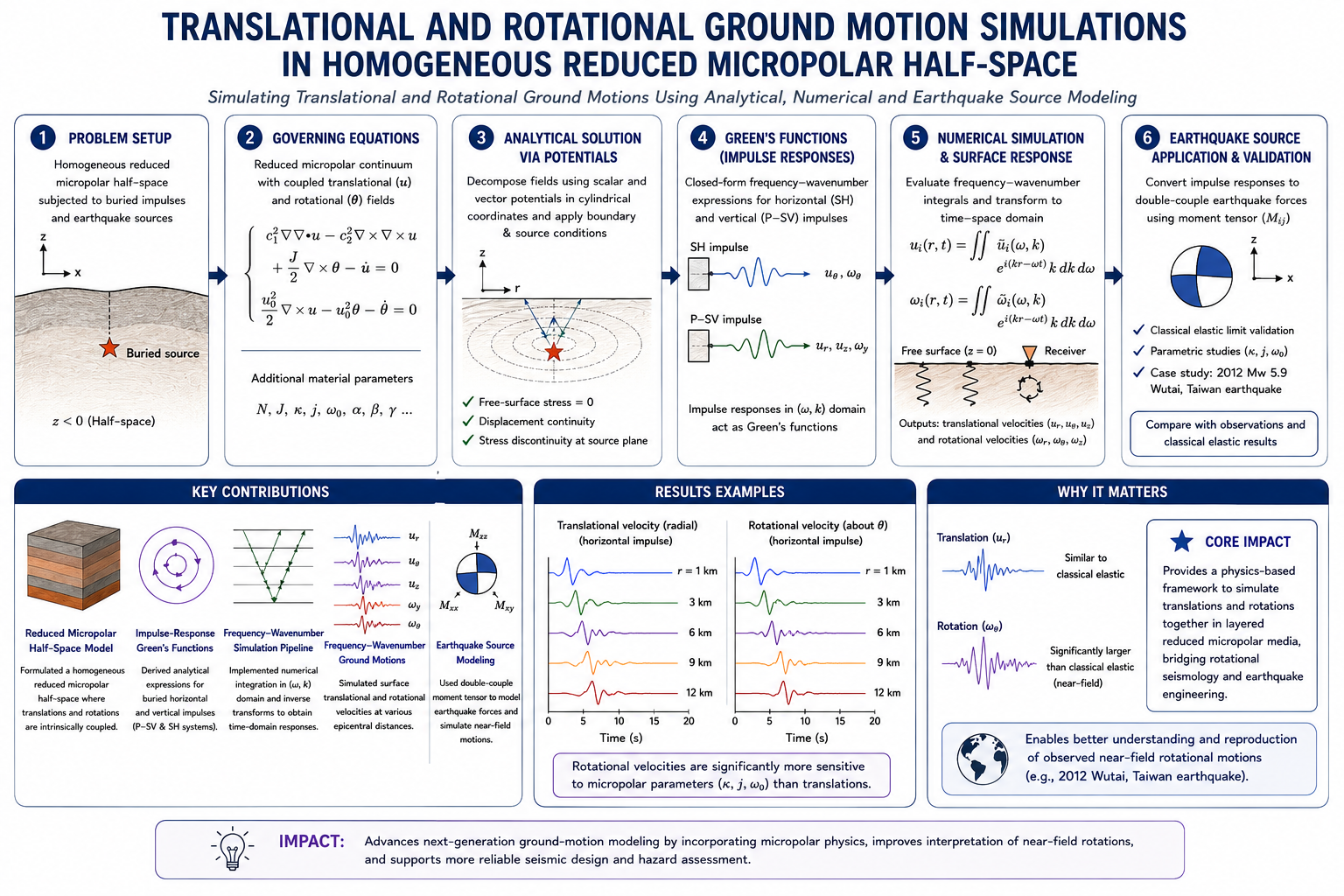
Reduced Micropolar Theory for Rotational Ground-Motion Simulation
Research BriefRotational ground motions are increasingly measurable, but conventional elastic models can underestimate them because they represent the Earth medium primarily through translation-focused continuum mechanics. This work explored reduced micropolar theory as an alternative medium model that can represent micro-rotational effects while remaining simpler than full micropolar elasticity.
Area, Method, and Outputs
AreaGround-Motion TheoryMethodLayered Reduced Micropolar MediaOutputJGR: Solid Earth Publication and Ph.D. ResearchToolReduced Micropolar TheoryToolFrequency-Wavenumber Green's FunctionsToolP-SV and SH Wave PropagationToolNumerical Ground-Motion Simulation
Translational and Rotational Ground-Motion Simulation in Reduced Micropolar Half-Space
Research BriefDerived analytical Green's functions and built a numerical simulation workflow for translational and rotational ground motions in a homogeneous reduced micropolar half-space under impulse and double-couple earthquake loading.
Area, Method, and Outputs
AreaRotational SeismologyMethodAnalytical Ground-Motion ModelingOutputHomogeneous Half-Space, Impulse Loads, Mw 5 Benchmark, 2012 Wutai EarthquakeToolReduced Micropolar TheoryToolGreen's FunctionsToolDiscrete Wavenumber MethodToolMATLABToolDouble-Couple Earthquake Source Modeling