
Hamburg, Germany
WorkJuly 22, 2019

Seismically Active Lobate Scarps and Lunar Boulder Avalanches

Co-authored a Geophysical Research Letters study linking the 3 January 1975 Mw 4.1 shallow moonquake at Laue crater with young lobate scarps, coseismic boulder avalanches, crater-age constraints, and lunar ground-motion simulations.View publication or abstract
AreaPlanetary SeismologyMethodShallow Moonquakes and Lunar Lobate ScarpsOutputGeophysical Research Letters PublicationToolLRO NAC and WAC Image AnalysisToolLOLA and Kaguya TopographyToolCrater Size-Frequency DatingToolLunar Ground-Motion Modeling
Seismically Active Lobate Scarps and Lunar Boulder Avalanches
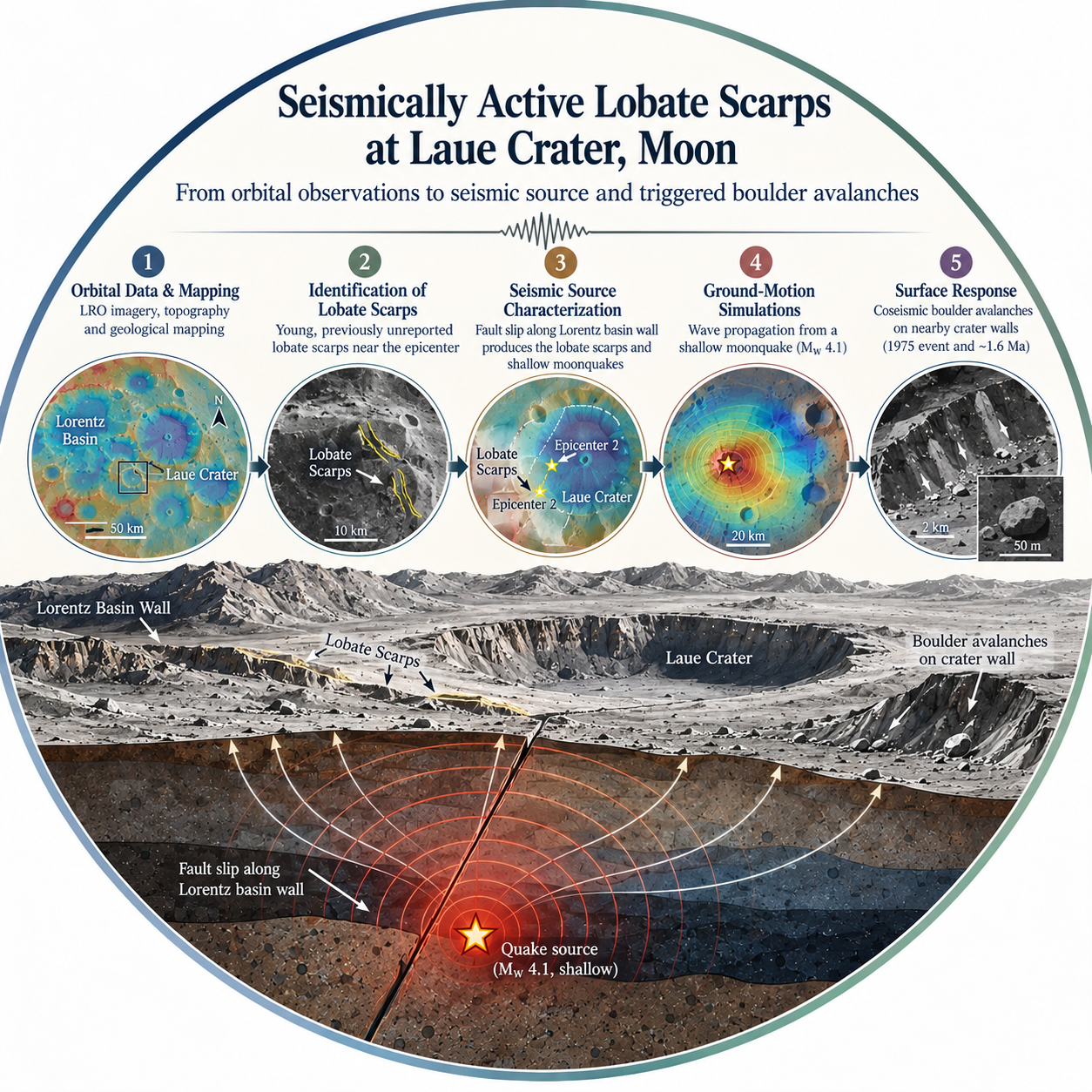
This planetary-seismology study investigated the 3 January 1975 shallow moonquake at Laue crater, the largest shallow moonquake recorded by the Apollo seismic network. The work connected previously unreported young lobate scarps, lunar boulder avalanches, crater-age constraints, and synthetic ground-motion simulations to identify the likely seismogenic structure responsible for the event. The study showed that boulder falls on nearby crater walls can preserve evidence of coseismic shaking on the Moon. It also linked the lobate scarps on the Laue crater floor to fault slip along the buried Lorentz basin wall, providing a geological explanation for the recorded shallow moonquake. Apollo seismometers recorded 28 shallow moonquakes between 1969 and 1977, but the faults responsible for individual events were not always known. The 3 January 1975 event was especially important because it was the largest recorded shallow moonquake, with moment magnitude Mw 4.1 and high stress drop. The central research question was whether high-resolution lunar surface observations could identify the active fault source of this moonquake and explain the origin of boulder avalanches on nearby impact-crater walls. The work focused on Laue crater, a 92 km diameter complex impact crater superimposed on the Lorentz peak-ring basin. The mapped lobate scarps occur west of the Laue crater central peak and lie within the location uncertainty of the 1975 shallow moonquake epicenter. The analysis used Lunar Reconnaissance Orbiter Camera Narrow Angle Camera images, Wide Angle Camera mosaics, Lunar Orbiter Laser Altimeter topography, merged Kaguya-LOLA topographic data, and GRAIL gravity and crustal-thickness products. These datasets supported mapping of lobate scarps, boulder-fall trails, crater-wall topography, basin-wall structure, and age constraints from superimposed impact craters.
  • Lunar geomorphologic mapping: Mapped previously unreported lobate scarps on the Laue crater floor and boulder-fall trails on the walls of two nearby impact craters.
  • Structural interpretation: Related the location and orientation of the scarps to the buried Lorentz basin wall using gravity and crustal-thickness information.
  • Boulder-fall classification: Separated boulder avalanches into generations using preservation state, cross-cutting relations, and superimposed impact craters.
  • Crater size-frequency dating: Used crater-count analysis to estimate the model formation ages of older boulder-fall populations.
  • Ground-motion simulation: Modeled the Mw 4.1 shallow moonquake at 1 to 5 km focal depths using stochastic seismological methods.
  • Boulder rocking analysis: Evaluated whether simulated accelerations could topple meter-scale boulders at the two nearby crater walls.
  • Impact-trigger assessment: Estimated impact-generated seismicity from recent small craters to test whether impacts could explain the boulder avalanches.
  • Identified a 25 km long and 5 km wide zone of young lobate scarps on the Laue crater floor.
  • Mapped 19 lobate-scarp segments with lengths ranging from 0.3 to 11.2 km near the 1975 moonquake epicentral region.
  • Documented hundreds of boulder-fall trails on the walls of two nearby impact craters, located about 25 to 30 km from the relocated epicenter.
  • Distinguished younger, older, and trail-less boulder-fall populations using preservation state and superposition relations.
  • Used crater-size frequency distributions to show that one older boulder-fall generation formed around 1.6 Ma.
  • Demonstrated that the 1975 Mw 4.1 moonquake could have generated strong enough shaking to trigger the youngest boulder avalanches.
  • Showed that recent small impact events were too weak to account for the observed coseismic boulder falls.
  • The lobate scarps at Laue crater are the most likely seismogenic source of the 3 January 1975 shallow moonquake.
  • The scarps coincide with the buried Lorentz basin wall, suggesting reactivation of a basin-wall fault beneath Laue crater.
  • Crater 1 contains 435 prominent boulder trails, including 304 younger trails; Crater 2 contains 136 older and 256 younger trails.
  • Crater-count dating gave model ages of 1.55 +/- 0.54 Ma for one older boulder-fall population at Crater 1 and 1.62 +/- 0.34 Ma at Crater 2.
  • Younger boulder trails without superimposed craters were interpreted as likely coseismic features from the 1975 shallow moonquake.
  • Simulated ground motions for 1 km and 5 km focal depths produced peak accelerations strong enough to topple boulders at Craters 1 and 2.
  • Impact-generated seismicity from recent 5 to 8 m craters was much weaker than the 1975 moonquake and unlikely to explain the youngest boulder falls.
  • The coexistence of active lobate scarps and nearby boulder avalanches provides a way to identify seismically active zones on the Moon.
As a co-author, I contributed to the seismological and ground-motion interpretation of the lunar boulder-avalanche problem. The work connects my earthquake-engineering and strong-motion background with planetary questions about shallow moonquakes, active faults, and seismic shaking on airless bodies. A key challenge was linking an instrumentally recorded moonquake to a specific fault source using surface geology. The study addressed this by combining mapped lobate scarps, crater-wall boulder trails, crater-age constraints, gravity data, and synthetic ground-motion estimates. Another challenge was separating moonquake-triggered boulder avalanches from impact-triggered mass wasting. The comparison between shallow moonquake ground motions and recent impact-generated seismicity helped show that the youngest boulder falls are better explained by coseismic shaking from the lobate scarps. The paper provided geological evidence that the Laue crater lobate scarps are seismically active and genetically linked to the largest Apollo-recorded shallow moonquake. It also showed that boulder avalanches can act as surface markers of recent seismic shaking on the Moon. This project complements the Mars Valles Marineris study by extending the same planetary-seismology logic across two bodies: surface deformation, mass wasting, and ground-motion modeling can reveal active seismic processes where instrumental records are sparse or spatially limited. Kumar, P. S., Mohanty, R., Lakshmi, K. J. P., Raghukanth, S. T. G., Dhabu, A. C., Rajasekhar, R. P., & Menon, R. (2019). The seismically active lobate scarps and coseismic lunar boulder avalanches triggered by 3 January 1975 (Mw 4.1) shallow moonquake. Geophysical Research Letters, 46, 7972-7981. https://doi.org/10.1029/2019GL083580

Related projects

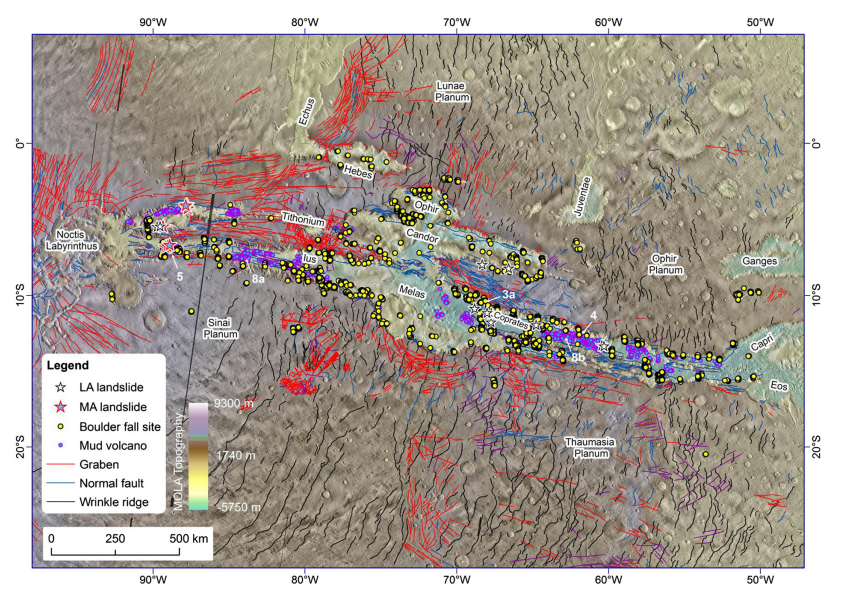
Recent Seismicity in Valles Marineris, Mars
Research BriefCo-authored an Earth and Planetary Science Letters study showing that Valles Marineris is recently seismo-tectonically active, using young faults, landslides, boulder falls, possible mud volcanoes, crater-age constraints, and synthetic marsquake ground-motion models.
Area, Method, and Outputs
AreaPlanetary SeismologyMethodValles Marineris Marsquake EvidenceOutputEarth and Planetary Science Letters PublicationToolMars Orbiter Image InterpretationToolFault and Boulder-Fall MappingToolCrater Size-Frequency DatingToolSynthetic Ground-Motion Modeling
Research Theme