Project Summary
Research Problem
Study Region and Data
Methods and Technical Expertise
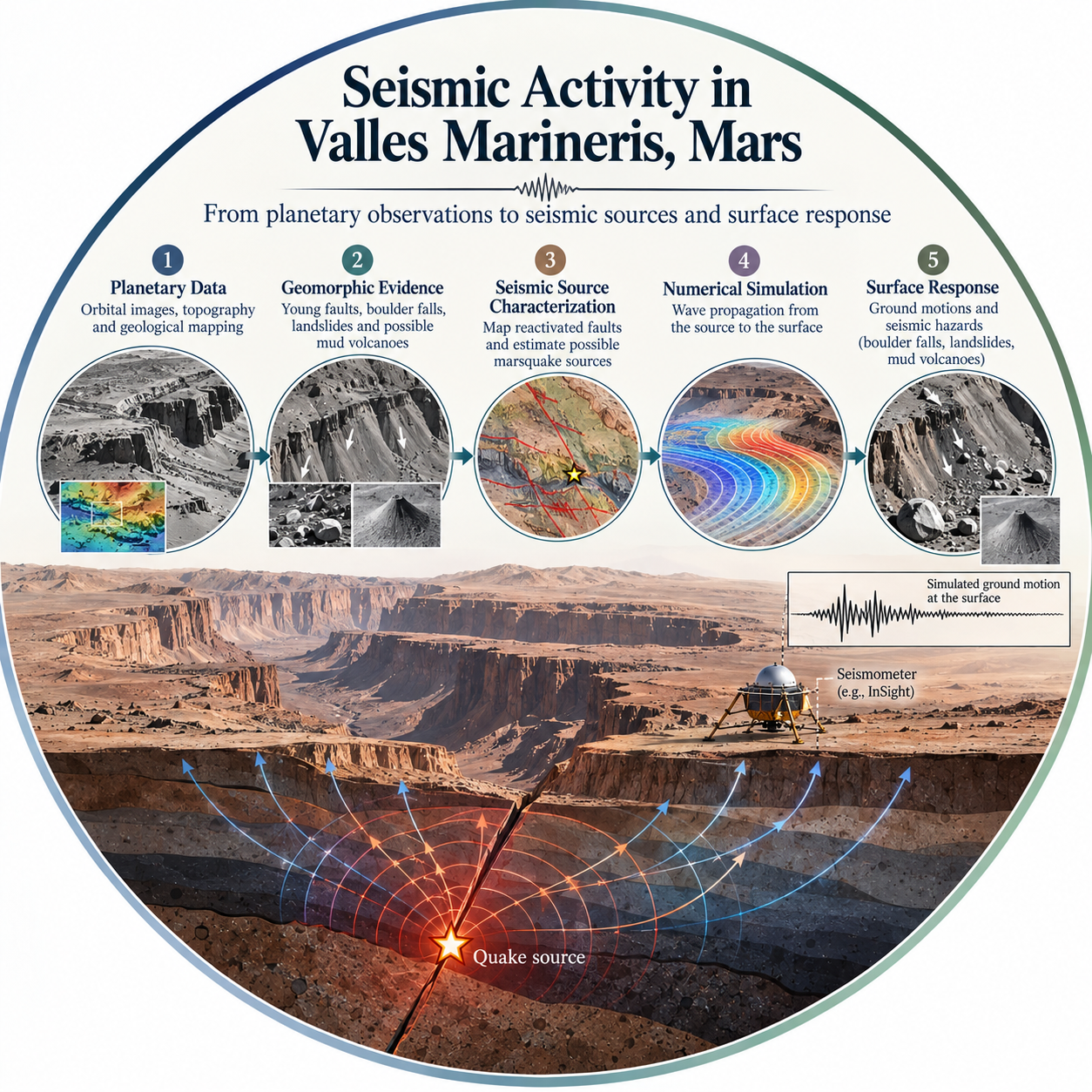
- Geomorphologic mapping: Mapped young and reactivated faults, landslide deposits, boulder-fall trails, possible mud volcanic cones, and fresh impact craters using Mars orbiter imagery.
- Fault interpretation: Examined cross-cutting relationships and displacement along trough-bounding faults to infer recent or renewed tectonic movement.
- Crater size-frequency dating: Used crater-density ages to estimate the timing of selected landslides and connect mass-wasting events with Middle to Late Amazonian activity.
- Boulder-fall analysis: Interpreted thousands of pristine boulder-fall trails as possible evidence of recent surface shaking on steep canyon walls.
- Impact assessment: Evaluated whether fresh impact craters could plausibly account for the inferred seismic shaking.
- Synthetic ground-motion modeling: Used stochastic ground-motion simulations to estimate the marsquake magnitudes and shallow source depths needed to explain canyon-wide boulder falls.
Research Contributions
- Demonstrated that Valles Marineris contains geological signatures consistent with recent seismo-tectonic activity.
- Identified reactivated dip-slip faulting that cross-cuts canyon walls and floors, with large cumulative vertical displacement along trough-bounding faults.
- Connected young landslide deposits near reactivated faults with possible marsquake-triggered shaking over tens to hundreds of millions of years.
- Mapped more than 16000 boulder-fall occurrences with fresh trails and interpreted them as potential markers of recent shallow marsquakes.
- Assessed fresh impact craters and found that impact-triggered seismicity was unlikely to explain the regional pattern of recent activity.
- Used synthetic ground-motion estimates to show that shallow Mw 4-6 marsquakes could produce the level of shaking needed for widespread boulder falls.
Key Findings
- Valles Marineris is likely one of the major recently active tectonic regions on Mars.
- The chasmata preserve evidence of young cross-cutting faults and reactivated trough-bounding faults.
- Boulder-fall trails are widespread across canyon walls and are consistent with recent seismic shaking.
- Many landslides near the reactivated faults have modeled ages between 22 and 790 Ma, placing them in the Middle to Late Amazonian.
- Thousands of possible mud volcanic cones on chasmata floors may also reflect shaking-related or fluid-mobilization processes.
- Fresh impact craters from about 20 m to 1.3 km diameter were estimated to have contributed negligibly to the recent seismicity signal.
- Valles Marineris tectonism could produce marsquakes detectable by InSight-class seismometers.