
Hamburg, Germany
WorkJanuary 1, 2019

Recent Seismicity in Valles Marineris, Mars

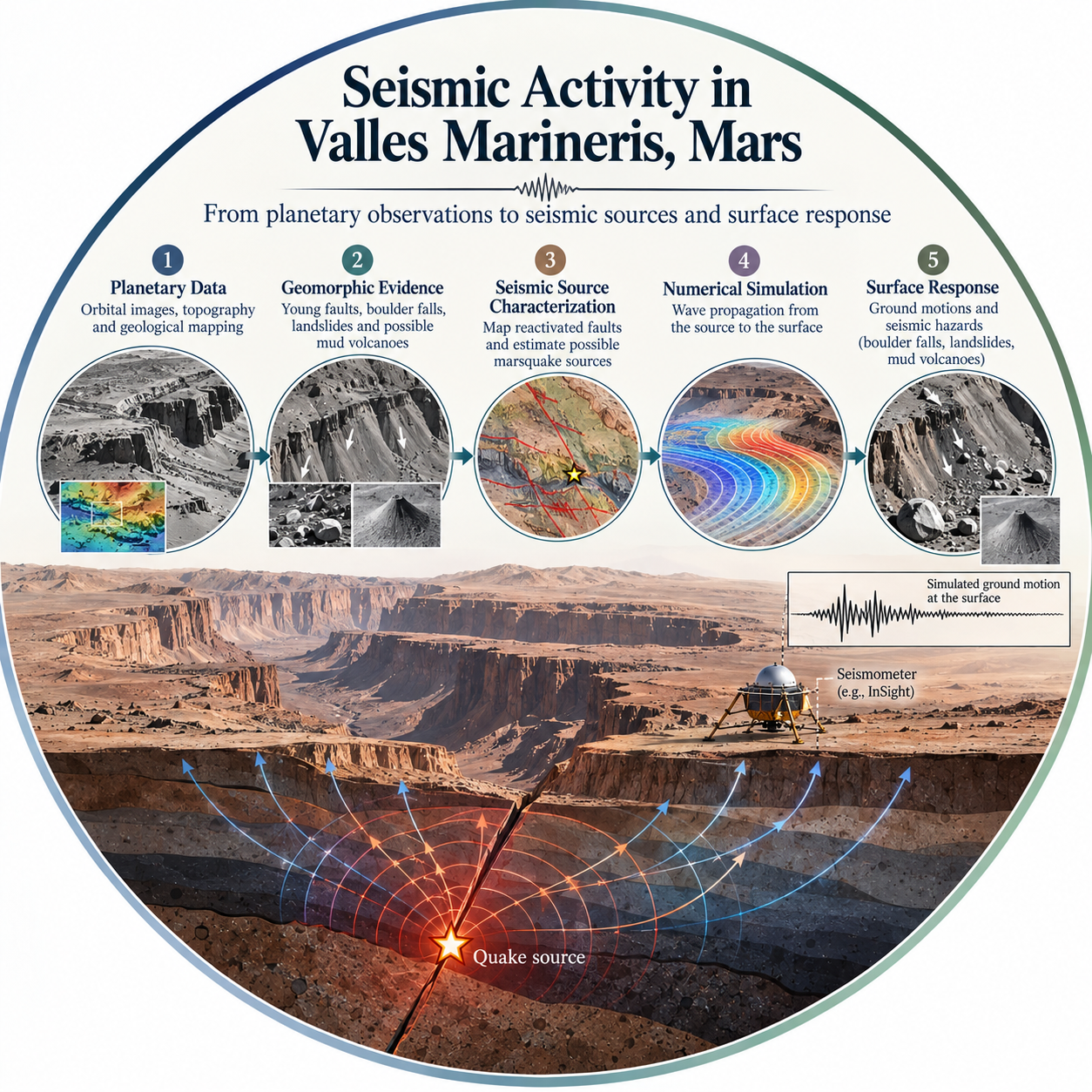
Co-authored an Earth and Planetary Science Letters study showing that Valles Marineris is recently seismo-tectonically active, using young faults, landslides, boulder falls, possible mud volcanoes, crater-age constraints, and synthetic marsquake ground-motion models.View publication or abstract
AreaPlanetary SeismologyMethodValles Marineris Marsquake EvidenceOutputEarth and Planetary Science Letters PublicationToolMars Orbiter Image InterpretationToolFault and Boulder-Fall MappingToolCrater Size-Frequency DatingToolSynthetic Ground-Motion Modeling
Recent Seismicity in Valles Marineris, Mars
This collaborative planetary-seismology study examined whether Valles Marineris, the largest canyon system on Mars, preserves geological evidence of recent seismo-tectonic activity. The work linked young faults, landslides, boulder-fall trails, possible mud volcanic cones, and synthetic ground-motion estimates to assess whether marsquakes could have shaped the chasmata in the recent geological past. The study argued that Valles Marineris is not only an ancient tectonic structure, but a region where recent fault activity and associated shaking may still be important. It connected geomorphology, crater-age constraints, and seismological modeling in the period just before NASA's InSight mission began recording marsquakes. Present-day seismicity on Mars was poorly constrained before InSight. Geodynamic models suggested that Mars could still be seismically active, especially around Tharsis, but direct geological evidence for recent marsquakes was limited. The central research question was whether surface features in Valles Marineris could record recent tectonic shaking, and whether fault-related marsquakes could explain the distribution of landslides, boulder falls, and possible mud-volcanic features better than recent impact events. The work focused on Valles Marineris and its surrounding region, a canyon system roughly 2000 km long, hundreds of kilometers wide, and several kilometers deep. The study used high-resolution orbital datasets to map structural and mass-wasting features across the chasmata. The analysis drew on THEMIS daytime infrared mosaics, CTX imagery, HiRISE images where available, HRSC digital terrain models, MOLA topography, and crater-count information. These datasets were used to map faults, estimate landslide ages, identify boulder-fall trails, document possible mud volcanic cones, and assess fresh impact craters around the chasmata.
  • Geomorphologic mapping: Mapped young and reactivated faults, landslide deposits, boulder-fall trails, possible mud volcanic cones, and fresh impact craters using Mars orbiter imagery.
  • Fault interpretation: Examined cross-cutting relationships and displacement along trough-bounding faults to infer recent or renewed tectonic movement.
  • Crater size-frequency dating: Used crater-density ages to estimate the timing of selected landslides and connect mass-wasting events with Middle to Late Amazonian activity.
  • Boulder-fall analysis: Interpreted thousands of pristine boulder-fall trails as possible evidence of recent surface shaking on steep canyon walls.
  • Impact assessment: Evaluated whether fresh impact craters could plausibly account for the inferred seismic shaking.
  • Synthetic ground-motion modeling: Used stochastic ground-motion simulations to estimate the marsquake magnitudes and shallow source depths needed to explain canyon-wide boulder falls.
  • Demonstrated that Valles Marineris contains geological signatures consistent with recent seismo-tectonic activity.
  • Identified reactivated dip-slip faulting that cross-cuts canyon walls and floors, with large cumulative vertical displacement along trough-bounding faults.
  • Connected young landslide deposits near reactivated faults with possible marsquake-triggered shaking over tens to hundreds of millions of years.
  • Mapped more than 16000 boulder-fall occurrences with fresh trails and interpreted them as potential markers of recent shallow marsquakes.
  • Assessed fresh impact craters and found that impact-triggered seismicity was unlikely to explain the regional pattern of recent activity.
  • Used synthetic ground-motion estimates to show that shallow Mw 4-6 marsquakes could produce the level of shaking needed for widespread boulder falls.
  • Valles Marineris is likely one of the major recently active tectonic regions on Mars.
  • The chasmata preserve evidence of young cross-cutting faults and reactivated trough-bounding faults.
  • Boulder-fall trails are widespread across canyon walls and are consistent with recent seismic shaking.
  • Many landslides near the reactivated faults have modeled ages between 22 and 790 Ma, placing them in the Middle to Late Amazonian.
  • Thousands of possible mud volcanic cones on chasmata floors may also reflect shaking-related or fluid-mobilization processes.
  • Fresh impact craters from about 20 m to 1.3 km diameter were estimated to have contributed negligibly to the recent seismicity signal.
  • Valles Marineris tectonism could produce marsquakes detectable by InSight-class seismometers.
As a co-author, I contributed seismicity, earthquake-source, and ground-motion interpretation to the planetary-seismology collaboration. The work connected my background in earthquake engineering and strong-motion analysis with planetary-scale questions about active deformation and surface evidence on Mars. A central challenge was interpreting recent seismicity without direct instrumental marsquake records from Valles Marineris. The study therefore relied on multiple independent geological indicators: fault geometry, relative ages, landslide timing, boulder-fall preservation, possible mud volcanic features, and impact-crater assessment. Another challenge was translating terrestrial seismological and ground-motion reasoning to Martian conditions. The project required careful interpretation of what surface features can and cannot say about fault activity, shaking intensity, and possible marsquake sources on a single-plate planet. The paper strengthened the case that Valles Marineris is a plausible source region for recent and possibly present-day marsquakes. It also showed how planetary surface observations can be combined with seismological modeling to infer active deformation where direct seismic records are sparse. This work broadens my research profile from terrestrial earthquake ground motion to planetary seismology, while keeping seismic sources, ground-motion effects, and structural interpretation as the shared scientific thread. Kumar, P. S., Krishna, N., Prasanna Lakshmi, K. J., Raghukanth, S. T. G., Dhabu, A., & Platz, T. (2019). Recent seismicity in Valles Marineris, Mars: Insights from young faults, landslides, boulder falls and possible mud volcanoes. Earth and Planetary Science Letters, 505, 51-64. https://doi.org/10.1016/j.epsl.2018.10.008

Related projects

Seismically Active Lobate Scarps and Lunar Boulder Avalanches
Research BriefCo-authored a Geophysical Research Letters study linking the 3 January 1975 Mw 4.1 shallow moonquake at Laue crater with young lobate scarps, coseismic boulder avalanches, crater-age constraints, and lunar ground-motion simulations.
Area, Method, and Outputs
AreaPlanetary SeismologyMethodShallow Moonquakes and Lunar Lobate ScarpsOutputGeophysical Research Letters PublicationToolLRO NAC and WAC Image AnalysisToolLOLA and Kaguya TopographyToolCrater Size-Frequency DatingToolLunar Ground-Motion Modeling
Research Theme