Associated Projects
Projects in this theme.
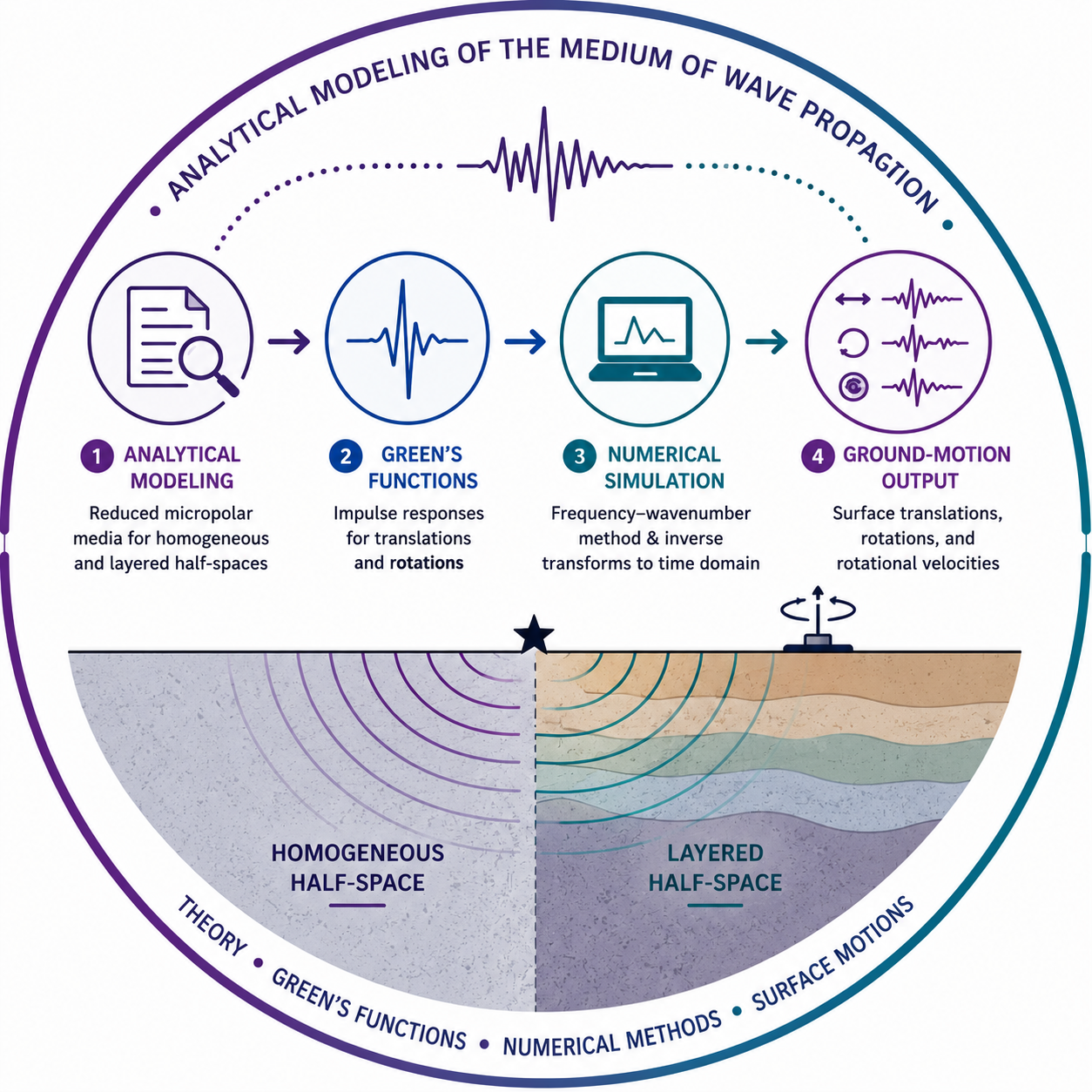
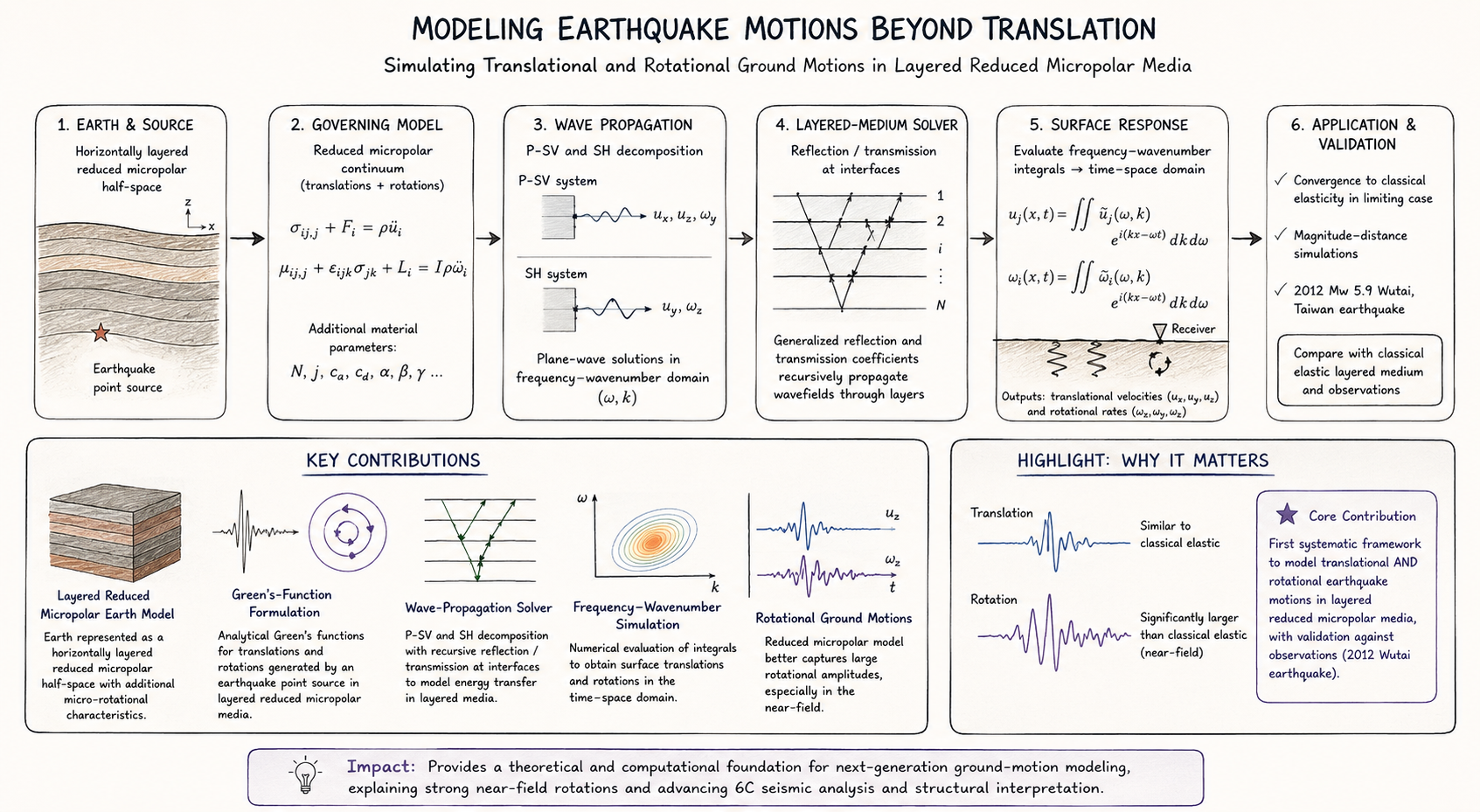
Each card opens a full project brief with the methods, outputs, collaborators, and publication context behind this research direction.Research BriefRotational ground motions are increasingly measurable, but conventional elastic models can underestimate them because they represent the Earth medium primarily through translation-focused continuum mechanics. This work explored reduced micropolar theory as an alternative medium model that can represent micro-rotational effects while remaining simpler than full micropolar elasticity.
Area, Method, and OutputsAreaGround-Motion TheoryMethodLayered Reduced Micropolar MediaOutputJGR: Solid Earth Publication and Ph.D. ResearchToolReduced Micropolar TheoryToolFrequency-Wavenumber Green's FunctionsToolP-SV and SH Wave PropagationToolNumerical Ground-Motion Simulation
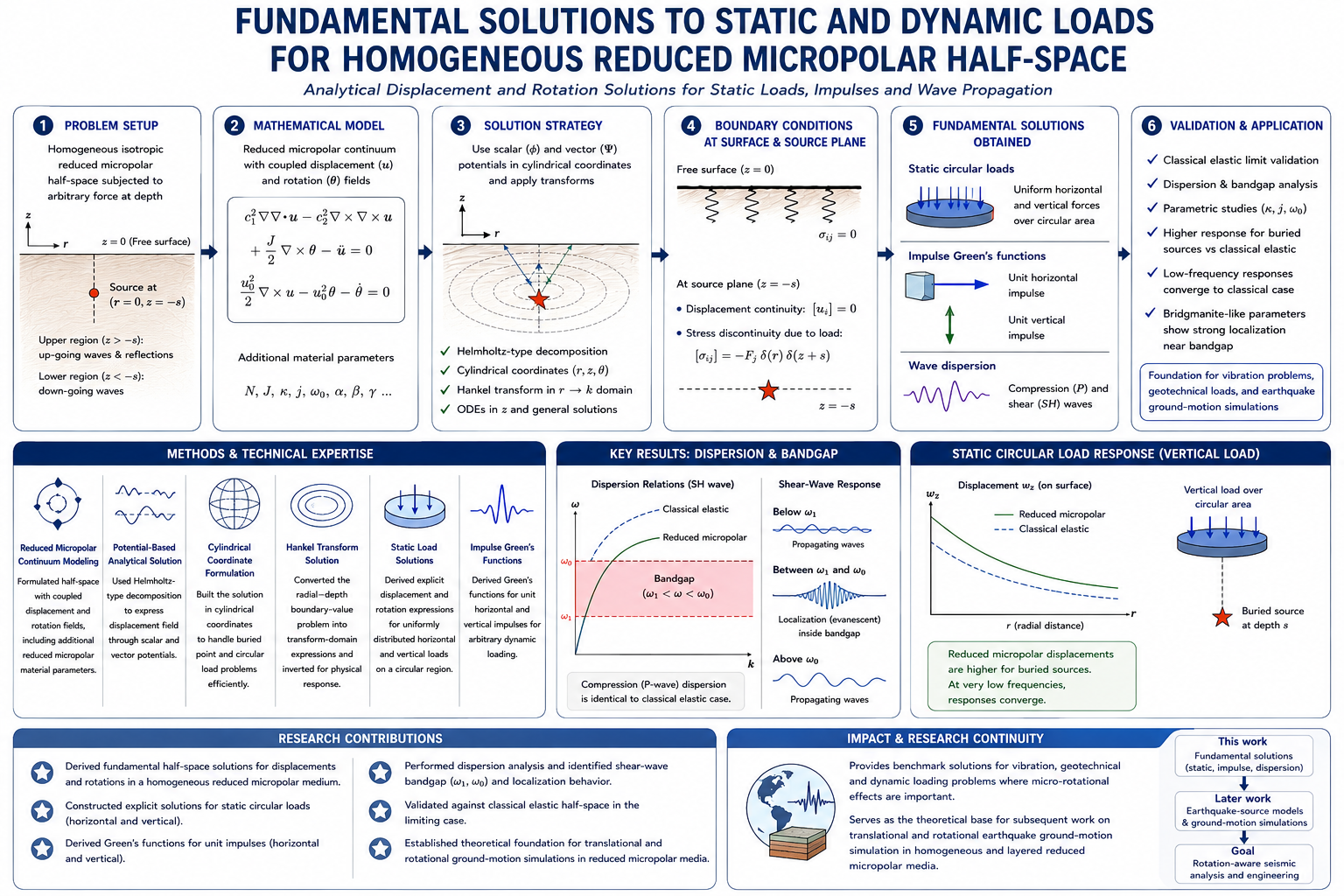
Research BriefDerived fundamental displacement and rotation solutions for static and dynamic loading in a homogeneous reduced micropolar half-space, including uniformly distributed circular loads, impulse Green's functions, classical-elastic validation, and dispersion analysis.
Area, Method, and OutputsAreaGround-Motion TheoryMethodFundamental Solutions for Reduced Micropolar MediaOutputPure and Applied Geophysics Publication and Ph.D. ResearchToolReduced Micropolar TheoryToolMethod of PotentialsToolHankel TransformsToolGreen's FunctionsToolDispersion Analysis
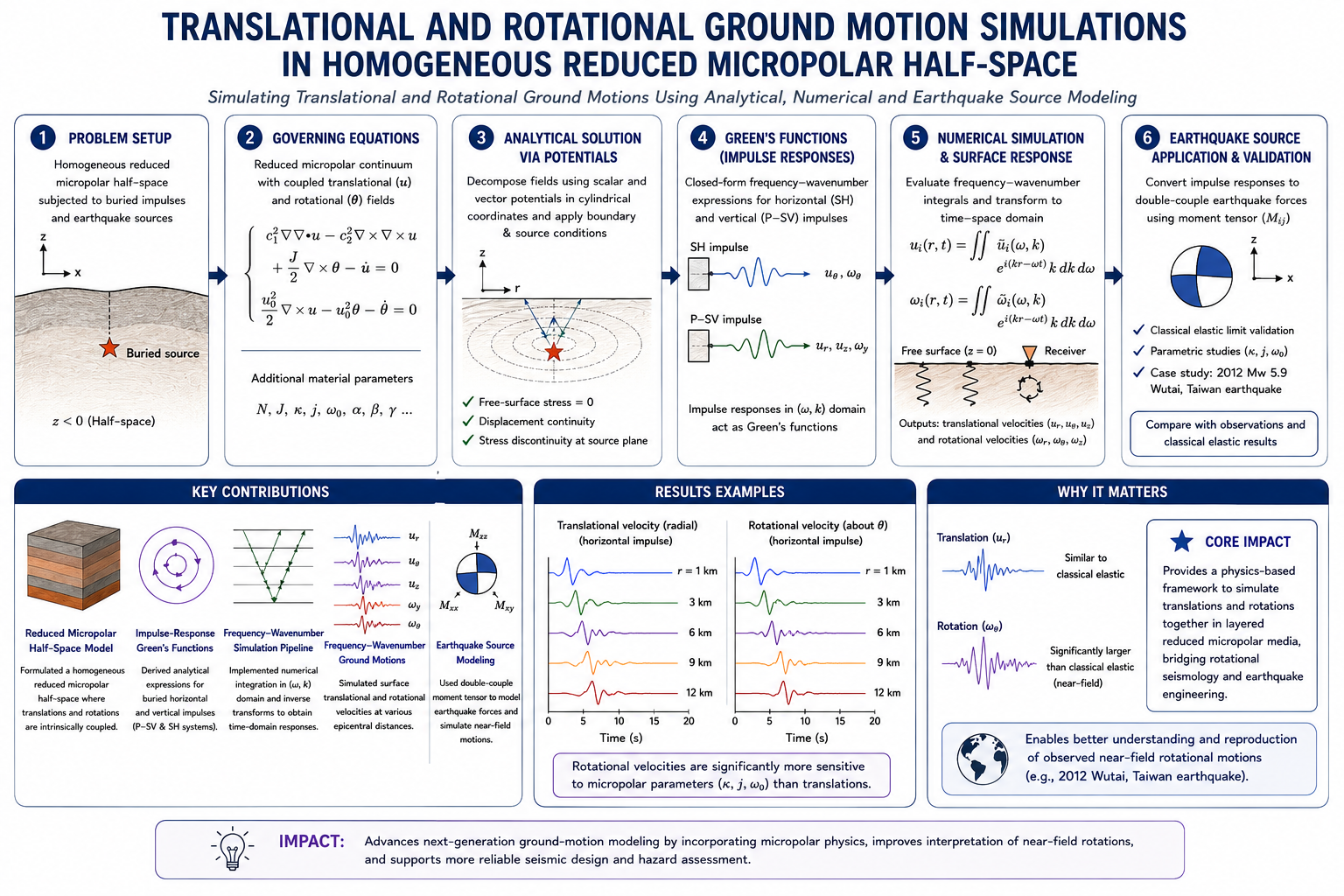
Research BriefDerived analytical Green's functions and built a numerical simulation workflow for translational and rotational ground motions in a homogeneous reduced micropolar half-space under impulse and double-couple earthquake loading.
Area, Method, and OutputsAreaRotational SeismologyMethodAnalytical Ground-Motion ModelingOutputHomogeneous Half-Space, Impulse Loads, Mw 5 Benchmark, 2012 Wutai EarthquakeToolReduced Micropolar TheoryToolGreen's FunctionsToolDiscrete Wavenumber MethodToolMATLABToolDouble-Couple Earthquake Source Modeling